

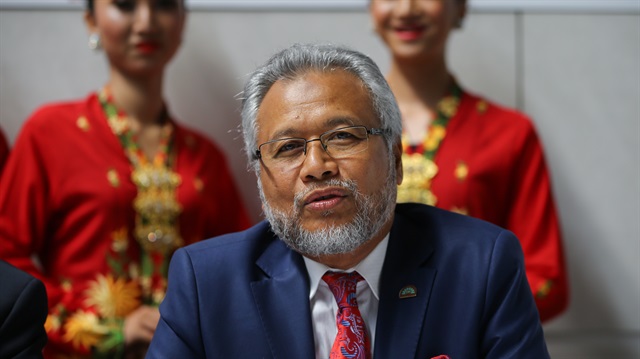
D-8 Secretary General Ambassador Dato Ku Jaafar Ku Shaari
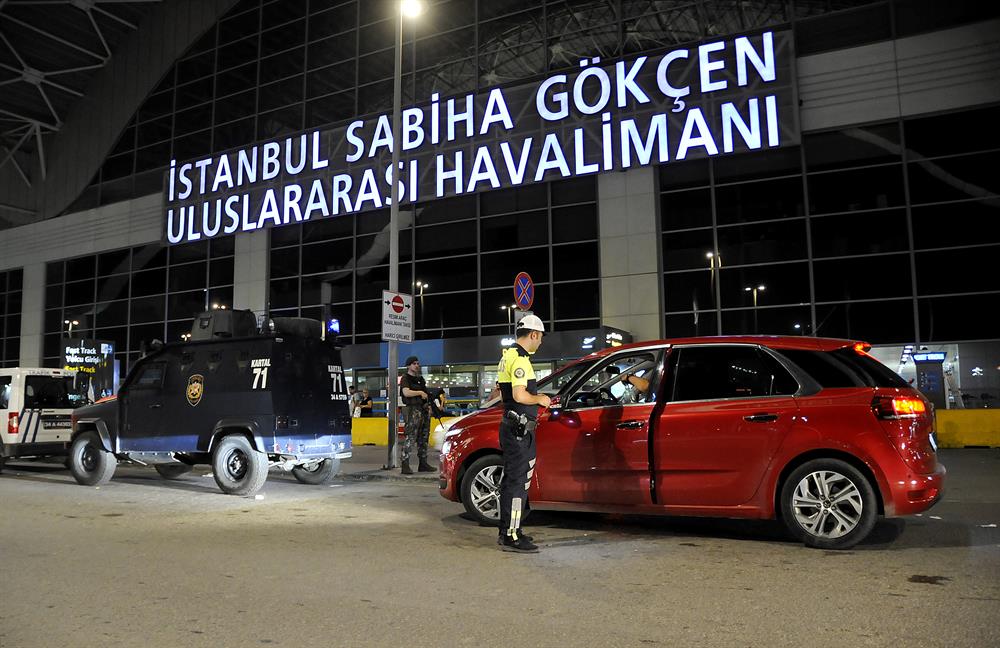
Istanbul Sabiha Gökçen International Airport (ISG) will be one of the designated airports of the D-8 Organization for Economic Cooperation.
A letter of intent was signed between ISG, which is located at the Asian side of the city, and D-8, also known as "Developing-8", to enhance cooperation among the member countries.
The deal was inked by Azmi Murat, the ISG executive director, and D-8 Secretary General Ambassador Dato Ku Jaafar Ku Shaari.
"The letter of intent specifies our desire to cooperate and to found partnership between Sabiha Gökçen International Airport and the D-8," Shaari said.
The new building at Istanbul’s Sabiha Gokcen Airport’s domestic terminal -- representing a €26 million ($30.5 million) investment -- will boost the airport's annual passenger capacity to over 40 million, Istanbul’s governor said on Tuesday."It started with a capacity of 25 million people, reached 31 million, and now is being raised to 41 million," Vasip Sahin said at the building’s opening ceremony.Looking ahead, he added: "With the second runway, this capacity will reach 63 million."Ismail Demir, Turkey's defense industry undersecretary, said that despite the opening of Istanbul's new airport this fall, the expansion of Sabiha Gokcen will continue.Set to open on Oct. 29, the upcoming third airport will be the world's biggest project built from scratch.In the first phase, the airport will welcome 90 million passengers annually. In the second phase, expected in 2023, the number is projected to rise to 150-250 million."We hope the second runway, the second terminal, and the expansion will come one after another," said Demir.Ersel Goral, the CEO of Sabiha Gokcen Airport Investment Development and Operation (ISG), said that airport's passenger traffic grew eightfold over the last decade, last year reaching 31.2 million persons."We expect the second runway -- which will cost approximately $1 billion -- to be completed in 2019," Goral said.In the first half of 2018, more than 97.6 million people travelled through airports in Turkey, according to the State Airports Authority (DHMI) Directorate.Some 1.38 billion people passed through the country's airports during the last 10 years, said DHMI data.
Expansion to boost Istanbul airport capacity to 41M
"Sabiha Gökçen International Airport will not only be the designated airport of the D-8 but also it will provide Fast Track Lane to the citizens of D-8."
The deal also aims to "provide a better connection between people to people, between business to business, between tourists and travelers," he added.
As part of the letter of intent, ISG will also provide lounge services for all travelers from D-8 member states.
"We can show how members states of D-8 to facilitate the needs of the citizens of the D-8 in order to develop economic cooperation, economic development, economic growth, and at the same time, uplifting the standard of living of all citizens of member states," Shaari noted.
"We look forward to having closer relationships with the D-8 airlines particularly," he added.
For his part, ISG's Azmi Murat also expressed his gratitude over the signing a letter of intent with D-8.
Stating that Sabiha Gökçen has been the first designated airport of the D-8 he said: "We look forward to working closely with all the eight member countries."
"We are very ready to work [with] special facilities of the D-8 member countries," Murat added.
ISG will also assign spaces on billboards for D-8's marketing activities and will create air links among the member countries' airports.
Istanbul Sabiha Gökçen International Airport (ISG) will be one of the designated airports of the D-8 Organization for Economic Cooperation. A letter of intent was signed between ISG, which is located at the Asian side of the city, and D-8, also known as "Developing-8", to enhance cooperation among the member countries.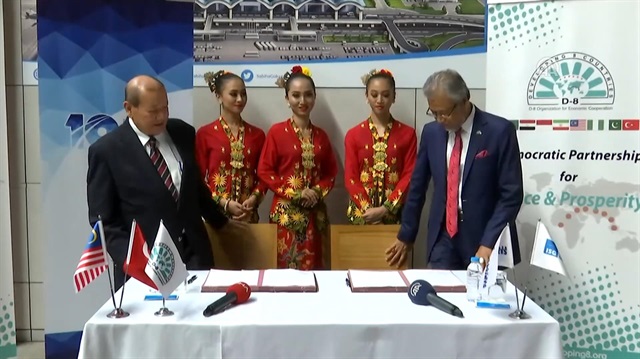
Istanbul's Sabiha Gökçen to be D-8’s designated airport
Turkey holds the rotating chairmanship of the D-8 for the next two years, and for the second time in 20 years.
On June 15, 1997, the D-8 was launched after late Turkish Prime Minister Necmettin Erbakan proposed the creation of an economic group consisting of eight emerging economies from the Muslim world.
Alongside Turkey, Indonesia, Bangladesh, Egypt, Iran, Malaysia, Nigeria, and Pakistan founded the organization based in Istanbul.
Today, two of its members -- Turkey and Indonesia -- are among the group of the world’s 20 biggest economies.