

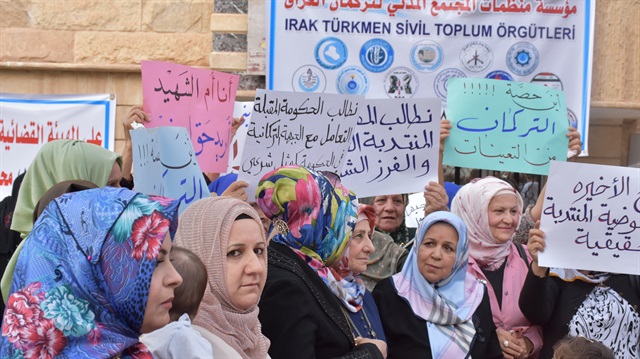
Fıle Photo
Turkey has a strong economy and will not be affected by current pressures against the country, a member of the Iraqi Turkmen Front (ITF) said Tuesday.
"Stability of the Turkish fiscal structure means stability of the Middle East economy,” Aydin Maruf told Anadolu Agency.
“The Iraqi Turkmens fully support the Turkish economy," he said.
The Turkish lira has recently lost ground against the dollar amid a raft of newly-imposed U.S. sanctions.
Maruf reiterated that Turkey would survive the ongoing pressures against the country.
"These constraints will not have that much of an impact on Turkey. It will continue for a short time before fading away,” he said. “Turkey will get over this and will be successful again.”
The Turkmen lawmaker said that Turkey’s economic and political development has annoyed some countries.
"The U.S. embargo aims to create a political pressure, but they will fail," he said, stressing that the Iraqi Turkmens have always stood by Turkey.
"The U.S-imposed pressure and sanctions on Turkey have distressed all parties,” he said. “Turkey is a significant country in the Middle East.
"They [Turkey] have always taken a firm stance in support of the oppressed people and communities in the region... Turkey is an important country for all the oppressed ethnic groups in the Middle East, not only for us [Turkmens],” Maruf said.
“The stability of the Turkish economy means financial stability in the Middle East. The political stability in Turkey is equivalent to political stability in the Middle East,” he added. “Turkey is the superpower in the Middle East, it is a great state."
Turkey-U.S. are currently experiencing rocky relations since Washington imposed sanctions on Turkey’s interior and justice ministers last week after Ankara refused to release an American pastor who faces terrorism-related charges in Turkey.
Last Friday, U.S. President Donald Trump doubled tariffs on aluminum and steel imports from Turkey.
Four Turkish companies have been named in the most prestigious defense industry list, Defense News Top 100.While Aselsan, Tusaş and Roketsan hold their places on the list, STM joined the list on Monday for the first time.In the U.S.-based magazine Defense News' annual list on company sales, Aselsan was ranked 55th, Tusas 64th, Roketsan 96th and STM 97th.Turkey's leading defense company Aselsan's 2017 income was $1.4 billion, up from $1.2 billion in the previous year. It is active in military and civil telecommunications, radar, electronic warfare, defense, weapons, command control and navigation systems.Tusas earned $1.1 billion in 2017 by manufacturing unmanned air vehicles (Anka), helicopters (Atak) and planes (Hurkus).Missile producer Roketsan and another defense industry company STM's incomes were $376 million and $369 million in 2017.The U.S.-based Lockheed Martin was ranked first in the list with nearly $48 billion; it was followed by the U.S.-based Raytheon Company ($23.6 billion) and the U.K.-based BAE Systems ($21.7 billion).Video: Turkey-produced ASELSAN artillery system breaks record
Four Turkish firms named among top 100 defense companies
Germany is Turkey’s “most important trading partner,” an official of Germany’s Ministry for Economic Affairs and Energy said."Germany is Turkey's most important trading partner, and the trade volume between the two countries is 37.7 billion euros ($43 billion)," Beate Baron, the Ministry’s spokeswoman, said at a news conference in Berlin.Baron said an assessment on whether the recent developments in Turkey would affect Germany could not be made at the moment.Jeannette Schwamberger, spokeswoman for Germany’s Finance Ministry, said she has no information on whether the developments in Turkey will be discussed among the G20 members or whether a meeting would be held on the issue.Schwamberger noted that the issues of currency and financial stability are monitored and analyzed by the relevant institutions and that the German Finance Ministry would not make an assessment on this issue.Turkey facing serious speculative attack: Banker'Germany would like to see an economically prosperous Turkey'Turkish minister hails Germany’s stance on US sanctions
'Germany is Turkey's most important trading partner'
Turkey is now facing a serious speculative attack lacking any economic basis, Adnan Bali, the CEO of private lender Işbank, said on Monday.When we look at Turkey's inflation, budget-deficit-to-GDP ratio, or debt-to-GDP ratio, the currency issue cannot be explained through economic fundamentals, he told BloombergHT and HaberTurk in a televised interview.Turkey's short-term -- 1 year or less -- liabilities total $180.6 billion, including $102 billion of them in lenders' obligations, with half of those non-residents' deposits, and the debts' refinancing ratio is 110 percent, he stressed.'Germany would like to see an economically prosperous Turkey'"Meanwhile, under the reserve option mechanism, banks have nearly $30 billion in the Central Bank, which provides $50 billion foreign exchange deposit limits for lenders," he said.Bali added: "Turkey's banking system has realizable foreign currency liquidity of around $50 billion. It refers to an unproblematic view."On private sector debt -- $73 billion -- he said their refinancing ratio is over 130 percent.Italy expects economic attack similar to TurkeyThere is no foreign exchange deficit in the Turkish banking system, according to Bali."The Central Bank and the banking watchdog's measures were positive," he stated.Today the Central Bank has said that it will provide banks' liquidity needs in addition to other measures.Last week there was balance in foreign currency transactions in Turkey, he highlighted adding that the country has crisis management experience and veteran managers.Erdoğan: Turkey’s economic dynamics are solidTurkey-US relations: From visionary to myopicTurkish minister hails Germany’s stance on US sanctionsTurkish economic structure solid: Presidential aideHow Turkey should respond to US’s economic war
Turkey facing serious speculative attack: Banker