

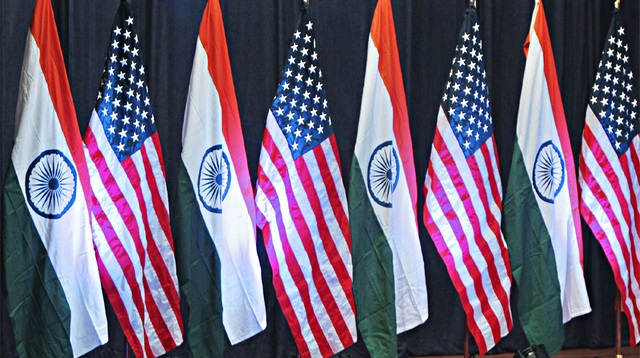
File photo
The bilateral defense and security collaboration between India and the U.S. has strengthened substantially over the recent years and their global strategic partnership, particularly in the Indo-Pacific region, has received a big boost.
India and the U.S. have traditionally maintained close and friendly relations. The defense relationship between the two countries has been one of mutual trust and confidence, which translated into the U.S. according major defense partner status to India in June 2016. In addition, both countries have concluded certain major agreements, which include the Defense Framework Agreement, signed in 2015, which lays a blueprint for collaboration between the defense establishments of both countries; the Logistics Exchange Memorandum of Agreement (LEMOA) signed in 2016, which is a foundational agreement, facilitating reciprocal logistics support between the Armed Forces of both countries; and the more recent Communications Compatibility and Security Agreement (COMCASA) signed on Sept. 6, 2018 that will allow India to procure U.S. defense technology and facilitate information-sharing between the Armed Forces of both countries.
Defense cooperation between India and the United States got a big boost when they signed LEMOA, a key defense pact to use each other’s bases for repair and replenishment of supplies.
India’s burgeoning #MeToo movement is claiming victory following junior Foreign Minister M.J. Akbar’s resignation after being accused of sexual harassment.Akbar came under fire after women journalists wrote first-person accounts of the sexual harassment and molestation they said they faced from him during his time as a celebrated newspaper editor.“The Editors Guild of India salutes the courage shown by several women journalists in bringing to light instances of how they were sexually harassed. The resignation of Mr. M.J. Akbar from the Union Council of Ministers is a result of these women journalists’ courage to fight for a high principle: gender equality in the newsroom,” the guild said in a statement Thursday.Akbar, however, has denied any wrongdoing and said he was stepping down so he could fight the allegations in court. He has also filed a criminal defamation case against journalist Priya Ramani, who was the first to write about his alleged unwanted sexual advances. A Delhi court began proceedings Thursday in the suit filed by Akbar.“As women, we feel vindicated by M.J. Akbar’s resignation. I look forward to the day when I will also get justice in court,” Ramani said Wednesday.The Editors Guild warned Akbar to withdraw the defamation case or they would extend their support to the women he will be fighting in court.“We hope that Mr. Akbar will also display the grace to withdraw the criminal defamation case he has filed against one of these complainants. While Mr. Akbar is entitled to all legal instruments available to a citizen to seek vindication, it would be paradoxical for a veteran editor to employ the instrument of criminal defamation. But if he doesn’t, or in case he files such cases against other women too, the Guild offers its support to them.”While Akbar’s resignation has so far been the high point of India’s #MeToo movement, the movement itself began when Bollywood actress Tanushree Dutta said senior star Nana Patekar sexually harassed her on sets.Since then, several Bollywood big names including veteran actor Alok Nath, directors Sajid Khan and Vikas Bahl, singer Anu Malik and several others have been accused of sexual harassment. They have denied the allegations.Several journalists and comedians have been called out as well.“The #MeToo movement in India is a great moment in this country’s history where the glass ceiling has been broken, where women are not blaming themselves for sexual harassment and keeping quiet about it but are instead calling out the perpetrators,” renowned women’s rights activist Brinda Adige told Anadolu Agency.“It is a great thing that this case has gone to the court and the Indian legal system too must keep with it and change its procedures and processes and not go about in a very slow and cumbersome manner in which cases take years and years without producing any results.”Adige said the women’s testimonies in these cases should be given a lot of consideration and the witnesses and their identities should be protected.One of the laws in which change is sought is one that lays down a three-month period for filing cases against sexual harassment, as most of the #MeToo cases that have come up happened several years ago.India’s Women and Child Development Minister Maneka Gandhi last week proposed to set up a committee to look into all issues emanating from the #MeToo campaign.Saira Shah Halim, a social and women’s rights activist, also welcomed Akbar’s resignation.“Mr. M.J. Akbar stepping down is a victory to the movement in the country. It is an important movement for the country, because several women have now come forward and have shared their pain. It will set a precedent for the future,” Halim told Anadolu Agency. “Serious and real issues need to be talked about under the movement because it could derail the entire movement if issues which don't come under the umbrella are discussed under the movement. For example, a man complementing a woman doesn’t need to be discussed under the #MeToo movement.”
India's #MeToo activists welcome minister’s resignation
The bilateral LEMOA has given access to both countries to use each other’s designated military facilities and helped the two militaries to coordinate better.
After the signing of the LEMOA, the military-to-military ties between India and the US have been growing rapidly.
The two nations began a new generation of military and security cooperation when they signed the ground-breaking COMCASA after 2+2 talks. The agreement will enable the two militaries to boost their interoperability and share operational intelligence in real-time.
COMCASA is an India-specific version of the Communication and Information on Security Memorandum of Agreement (CISMOA). It comes into force immediately, and is valid for a period 10 years.
Southeast Asian defence ministers on Friday agreed to a set of guidelines to manage unexpected aerial encounters between their military aircraft, and a deal to exchange information on terrorism and extremism.The leaders of the ten-nation Association of Southeast Asian Nations (ASEAN) grouping signed the joint declaration following a meeting in Singapore.A code to manage unexpected encounters at sea already exists and was adopted last year by ASEAN countries alongside Australia, China, India, Japan, New Zealand, South Korea, Russian Federation, and the United States.All 10 also agreed to adopt the "our eyes" initiative, launched by six member-states in January, as a platform to exchange information on terrorism, radicalism, violent extremism, and other "non-traditional" threats in the region. 
Southeast Asia agrees guidelines on air encounters, terrorism data swaps
India will now receive sophisticated military communications equipment and real-time encrypted information from the U.S. COMCASA will also enable India to access advanced U.S. defense systems and procure U.S. defense technology.
India’s Defense Minister Nirmala Sitharaman has said that the COMCASA is a historic step forward in strengthening the relationship between the two nations.
The signing of CISMOA follows the crucial 2+2 dialogue between the two countries. The India-U.S. Ministerial 2+2 Dialogue was a reflection of the shared commitment by Indian Prime Minister Narendra Modi and U.S. President Donald Trump to provide a positive, forward-looking vision for the India-U.S. strategic partnership and to promote synergy in their diplomatic and security efforts. India’s Minister of External Affairs Sushma Swaraj and Minister of Defense Nirmala Sitharaman held talks with U.S. Secretary of State Michael R. Pompeo and Secretary of Defense James N. Mattis. They resolved to continue meetings in this format on an annual basis.
India and China launched a programme on Monday to train Afghan diplomats and China's ambassador said it would likely be followed by joint programmes in other fields to help war-torn Afghanistan.Such cooperation is the first by the two Asian giants which have long been locked in a tussle for influence in a region stretching from Nepal to Sri Lanka and the island chain of the Maldives.Within Afghanistan, India and the China have been on opposite sides with China relying on its old ally Pakistan as it seeks to stabilise Afghanistan by various means, including brokering talks to end the Taliban insurgency.India, on the other hand, has invested billions of dollars in economic projects and training of military officers to strengthen the Afghan government in its fight against the Taliban.Leader of Russia-backed Crimea to visit SyriaFor its part, Pakistan sees the expansive diplomacy in Afghanistan by its old rival, India, as a way to encircle it.China's ambassador to India said the joint training of 10 Afghan diplomats at the Indian Foreign Service Institute was the first step in China-India-Afghanistan cooperation that was agreed at a summit between President Xi Jinping and Indian Prime Minister Narendra Modi this year."This is just the beginning. China and India have respective advantages. For example, India has remarkable edge in agriculture and medical services, and China in hybrid rice and poverty reduction," the ambassador, Luo Zhaohui, said in a speech."I am sure that in the future days China-India cooperation in Afghanistan will span from training programme to more concrete projects."Taliban attacks in Afghanistan kill at least 22 security forcesModi and Xi agreed to handle long-standing political differences peacefully at their summit in China, just months after a dispute over a stretch of their Himalayan border near the tiny state of Bhutan rekindled fears of war.Luo said India-China cooperation in Afghanistan should be extended to countries such as Bhutan, Nepal, the Maldives, Myanmar and even Iran.In many of these countries, China is helping to build infrastructure as part of its Belt and Road Initiative, which India sees as a bid by China to expand its influence.China's call for partnership comes just a week after its embassy in New Delhi said India and China must deepen their cooperation to fight trade protectionism, as it criticised the United States for what it termed provoking disputes. US envoy talks with Taliban, then back in Kabul
India, China launch joint training for Afghanistan, plan more projects
Recognizing that their two countries are strategic partners, major and independent stakeholders in world affairs, the ministers committed to work together on regional and global issues, including in bilateral, trilateral and quadrilateral formats. The two sides further decided to establish secure communication between the minister of foreign affairs of India and the U.S. secretary of state and between the minister of defense of India and the U.S. secretary of defense, to help maintain regular high-level communication on emerging developments.
India is concerned about possible changes in U.S. visa norms and took up the H-1B visa issue during the 2+2 Dialogue. The number of H-1B visas from India have gone up from 108,000 in 2014 to 129,000 in 2018. But the danger of reduction in the number of H1B visas is looming large after Trump's “Buy American, Hire American” policy. The Indian government has raised the issue of changing the H-1B visa regime with U.S. decision-makers at various levels, including the White House and State Department. The issue was effectively raised during the 2+2 Dialogue and U.S. representatives assured their Indian counterparts that they would seriously consider India’s concerns.
In February this year, the Trump administration came up with a new visa policy that makes the procedure for issuing H-1B visas stricter. As per the new policy, the hiring company would have to prove that its H-1B employee at a third-party worksite has specific and non-qualifying speculative assignments in specialty occupation. India has been telling the U.S. that skilled Indian professionals have contributed to the growth and development of U.S. economy.
Later India’s Foreign Minister Sushma Swaraj told reporters that she conveyed India’s expectation for a non-discriminatory and predictable approach to the H-1B visa regime, given its high impact on innovation, competitiveness and people-to-people partnership, all of which are a vital source of strength for Indo-U.S. relations.
Swaraj acclaimed Trump’s hardline Pakistan policies and the support India has been getting from the U.S. administration on the issue of terrorism in the region, particularly emanating from Pakistan. Welcoming the expansion of bilateral counter-terrorism cooperation, India and the U.S. announced their intent to increase information-sharing efforts on known or suspected terrorists. The two sides called on Pakistan to ensure that the territory under its control is not used to launch terrorist attacks on other countries.
The U.S. secretaries assured their Indian counterparts that the U.S. will continue its support to India in its bid to join the Nuclear Suppliers Group (NSG). The U.S. has been pushing for India's NSG membership. In the past, the U.S. has urged NSG members to support India's membership into the elite atomic trading bloc.
India’s Defense Minister Nirmala Sitharaman said the conclusion of the first ever Ministerial 2+2 between India and the United States is a concrete manifestation of the vision of their leaders, Prime Minister Narendra Modi and President Donald Trump, to take the India-U.S. relationship to a new level.
She said their leaders recognize that it is no longer viable to address foreign and defense issues in a compartmentalized manner. “We discussed a range of issues relating to our ties in a strategic framework and identified steps to take our relationship forward. Our discussions have paved the way for a new era in India-U.S. defense and strategic engagement. Given our shared interests, we are confident that we can work together to promote peace, economic prosperity and security in our region and beyond,” she said.
Recognizing their rapidly growing military-to-military ties, the two sides committed to the creation of a new, tri-services exercise and to further increase personnel exchanges between the two militaries and defense organizations. Acknowledging the unique role of technology in the India-U.S. defense partnership, the two sides reaffirmed their commitment to continue to encourage and prioritize co-production and co-development projects through the Defense Technology and Trade Initiative (DTTI) and to pursue other avenues of defense innovation cooperation.
America’s Deputy Assistant Secretary of State Alice Wells said in Washington that the 2+2 endorsed the strength of the India-U.S. relationship. “It reaffirmed the alignment of our interests and our values towards advancing an open, free and inclusive Indo-Pacific,” she said.
The Indian ministers welcomed the inclusion of India by the United States among the top tier of countries entitled to license-free exports, re-exports and transfers under the License Exception Strategic Trade Authorization (STA-1) and also committed to explore other means to support further expansion in two-way trade in defense items and defense manufacturing supply chain linkages.
Import of oil from Iran is an important issue for India as Iran is a major source of crude import. India enjoys friendly relations with Iran and after COMCASA, India is hopeful it would get concessions from the U.S. in importing oil from Iran in view of the sanctions imposed by the U.S. on the West Asian nation that will be effective from Nov. 4. India looks forward to similar leniency in the purchase of S-400 missiles from Russia in view of U.S. sanctions against Moscow relating to defense supplies. The S-400 missile system is believed to be the most powerful anti-aircraft and anti-missile system in service.
On the other hand, the U.S. values partnership with India to counter China’s expansionist behavior in the South China Sea. U.S. Secretary of State Michael Pompeo said both sides should ensure freedom of the seas and work toward peaceful resolutions of territorial and maritime disputes.
A week after the successful 2+2 Dialogue, India’s National Security Advisor Ajit Doval held talks with US Defense Secretary James Mattis, Secretary of State Mike Pompeo and John Bolton, National Security Advisor to Donald Trump, during which they discussed the future direction of the strategic Indo-U.S. ties.