

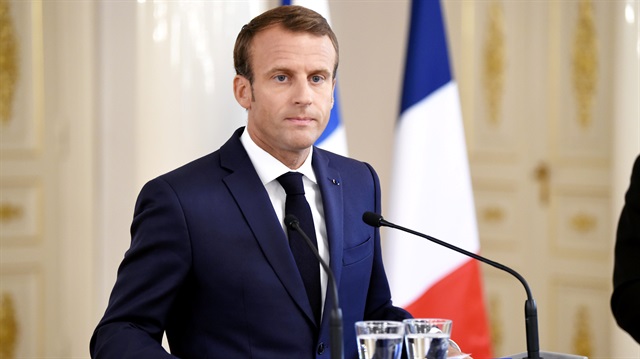
French President Emmanuel Macron
The European Union needs a strategic relationship with Turkey, including in defence matters, and should modernise its post-Cold War relations with Russia, French President Emmanuel Macron said on Thursday.
Macron is a strong advocate for a Europe that is able to defend its strategic interests and financial independence and respond to new global economic and defence situation brought on by Donald Trump's presidency in the United States.
He has sought to improve relations with Russia's President Vladimir Putin, although his efforts have been complicated by allegations of Russian meddling in elections from the United States to France and a nerve agent attack in Britain.
Turkish President Recep Tayyip Erdoğan on Thursday said that increasing threats and attacks on the country would not dissuade the country from its goals."The increasing threats, violations and attacks on our country’s sovereignty will never dissuade ud from our ideals and goals,” he stated during a speech in Anıtkabir, the mausoleum of the founder of the Turkish Republic Mustafa Kemal Atatürk.The Turkish leader’s message comes on the 96th anniversary of Victory Day, commemorating victory in the Battle of Dumlupınar, in Turkey's Aegean province of Kütahya in 1922, as part of the Great Offensive, which saw invading Greek forces' eventual defeat at the hands of the Turkish army.Video: Erdoğan marks 96th anniversary of Victory DayTurkey and the U.S. are currently experiencing rocky relations following Washington’s imposition of sanctions on two government ministers for not releasing American pastor Andrew Brunson, who faces terrorism-related charges in Turkey.President Donald Trump then ramped up his attack on Turkey by doubling U.S. tariffs on Turkish aluminum and steel imports, which caused the Turkish lira to lose value against the U.S. dollar.Turkey in its turn increased tariffs on several U.S. products, including alcohol, tobacco and cars, according to a new presidential decree published in the official gazette.Galeri: Turkey marks 96th anniversary of Victory DayTurkey's Victory Day tells world 'we are here to stay’'Turkey's economy strong enough,' Erdoğan says‘US to lose region if it loses Turkey,’ says expert
Attacks against Turkey’s sovereignty will never deter us from our goals: Erdoğan
"It is in our interest for the EU to have a strategic relationship with Turkey as well as with Russia that brings stability, that will in the long term and bring more strength and coherency," Macron said in a news conference in Helsinki alongside Finnish President Sauli Niinisto.
He said the EU's relations with Russia needed to be "brought up to date", using the Italian word "aggiornamento".
"I think that on matters like cybersecurity, defence, strategic relationships, we could envisage the outlines of a new relationship between Russia and the EU which is coherent with the direction Europe is headed in," Macron said.
"Stability in the whole region is in our interest."
Turkish defense minister and his Russian counterpart spoke over the phone about regional security, according to a Turkish ministerial source on Thursday.Turkey’s Hulusi Akar and Russia's Sergey Shoygu discussed regional security and the latest developments in Syria on a phone call, the source told Anadolu Agency on condition on anonymity due to the restrictions on speaking to the media.The ministers also exchanged views on bilateral cooperation, the source added.UN chief 'deeply concerned' by possible Idlib offensive‘US to lose region if it loses Turkey,’ says expertErdoğan hosts Iranian FM in AnkaraFrench FM urges for a political solution in Syria
Turkish, Russian ministers discuss regional security
Renowned Turkish historian Ilber Ortayli has said Turkey’s Victory Day, which commemorates the resounding defeat of Greek forces in the 1922 Battle of Dumlupinar, gives a message to the world that “we are here to stay”.In an interview with Anadolu Agency, Ortayli, an history professor at Istanbul's Galatasaray University, recalled that Seljuk Turks took control over Anatolia after the Battle of Dorylaeum with the then crusaders during the First Crusade in July 1, 1097, near the city of Dorylaeum located close to Turkey’s Eskisehir province.This allowed Turks to settle in Anatolia.Turkish domination in Anatolia began with the Battle of Malazgirt in Aug. 26, 1071, which saw Seljuk Turks led by Sultan Alparslan defeat a Byzantine army.‘US to lose region if it loses Turkey,’ says expertAbout the 1922 victory of Turkish forces over Greeks, the historian said: “Two factors were behind their dominance.“First, we [Turks] took control of not only the villages and the cities, but also the mountains,” Ortayli said.The second factor was the power of language that helped cement the dominance of Turks in Anatolia.“It was not in the bureaucracy or the madrasah… but in the army. In terms of language, the army was Turkish,” Ortayli said.French leader slammed for his remarks on TurkeyHe added that the inherited seminomadic tribal order of the Seljuks had also helped Turks to reinforce their dominance in Anatolia.Ortayli also pointed out that Anatolia was not a rich region when Turks had first arrived in the region.“However, for the first time in history, Turkish population was so dense in one region,” he said.Entente States' futile aims"The most populous region of the Turkic world is the Asia Minor. In no other country of the world, Turks have been so packed.Turkey to prioritize EU reforms, expects to see results: FM“There are Balkan countries… which we have left, there are also northern Syria and northern Mesopotamia.“If you include those, it makes a very big country. There was no population that was so crowded along the River Volga, or in Crimea, or even in Iran, or in Central Asia... For this reason, Turkey became an indispensable homeland."He recalled that the then global powers wanted Turks to leave Anatolia.“They [the then Entente States, also known as Allied Powers] tried to get it [Anatolia], but they failed to achieve their aim," Ortayli said, adding that the Entente states, especially Britain, wanted Turks to leave Anatolia on the grounds that they were supposedly “outlanders” and thus could not be a part of Anatolia.Turkey will shape the region’s future: ErdoğanTherefore, Turkey’s decisive victory on Aug. 30, 1922, which was later “legitimized” by the Lausanne Agreement, was a “we are here to stay” message to the world, Ortayli said.The well-known Turkish historian also recalled the Greek Commander Ioannis Metaxas’s warning against launching an offensive in Anatolia.Metaxas had refused to launch the offensive and told Greek politicians that the war in Turkey could not be won, Ortayli said.“The Turks developed a national feeling,” the author, David Fromkin, quoted Metaxas as saying in his book “A Peace to End All Peace”.“And they mean to fight for their freedom and independence… They realize that Asia Minor is their country and that we are invaders. For them, for their national feelings, the historical rights on which we base our claims, have no influence.Atatürk 'war genius'“Whether they are right or wrong is another question. What matters is their feelings,” according to the book.Ortayli said although the Turkish army had lacked even the basic equipment and weapons against the Greek Army, they were more experienced in fighting the war.The historian also highlighted Mustafa Kemal Atatürk’s ability to command the Turkish people, which, Ortayli said, had boosted the war-weary Turkish people’s energy to take part in their independence war.“Atatürk is undoubtedly a war genius who dared to do things which some other [Turkish commanders] could not dare to do."No other commander tried to rescue Bursa, Antalya or Izmir," he said.Ortayli added: “This war was won by Atatürk's military and political prodigy.”Turkey was occupied by allied forces after the defeat of the Ottoman Empire at the end of the First World War (1914-1918).The foreign occupation prompted Turkey’s War of Independence in 1919, in which Turkish forces -- led by Gen. Mustafa Kemal -- eventually drove the invaders from Anatolia.From Aug. 26 to Aug. 30 of 1922, Turkish forces fought the Battle of Dumlupinar (considered part of the Greco-Turkish War) in Turkey’s western Kutahya province, where Greek forces were decisively defeated.By the end of 1922, all foreign forces had left the territories which would collectively become the new Republic of Turkey one year later.
Turkey's Victory Day tells world 'we are here to stay’