

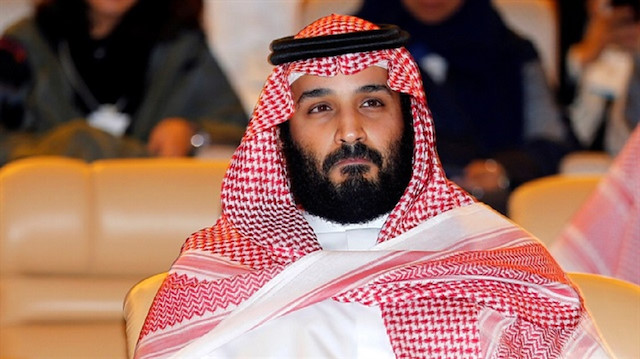
Saudi Crown Prince Mohammad bin Salman
The U.S.’s Central Intelligence Agency (CIA) has a recording of Saudi Crown Prince Mohammad bin Salman giving instructions to silence now-slain journalist Jamal Khashoggi, according to local reports.
The report, written by Hürriyet columnist Abdulkadir Selvi wrote on Nov. 22, claims CIA director Gina Haspel had "signalled" the existence of the recording during a visit to Ankara last month.
A Turkish official contacted by Reuters said he had no information about such a recording.
The U.S. has continuously supported Saudi Arabia because of oil, Iran and terrorism, however, these reasons are becoming increasingly indefensible, according to a foreign policy expert. The Eurasia Group Foundation (EGF)'s Mark Hannah responded to U.S. President Donald Trump's support for Saudi Arabia, despite reports the CIA concluded with high confidence that Saudi Crown Prince Mohammed bin Salman ordered the killing of journalist Jamal Khashoggi.Khashoggi, a Saudi journalist and columnist for The Washington Post, went missing after entering the Saudi Consulate in Istanbul on Oct. 2.After initially saying he had left the consulate alive, weeks later the Saudi administration admitted he was killed there.Trump maintained in a statement the U.S. needs Saudi Arabia because of its oil, its willingness to counter Iran and its ability to counter terrorism in the region.However, Hannah wrote that "none of these holds water."According to Hannah, the U.S. support for Saudi Arabia has led to a war in Yemen that is "one of the worst humanitarian crises in our lifetime," he wrote in the opinion piece for NBC News.As the conflict enters its fourth year, around 14 million people in Yemen, or half the total population, are at risk of famine, according to the U.N."Saudi Arabia, long a problematic U.S. partner, has gone rogue, and Washington’s stubborn support for it is increasingly indefensible," Hannah wrote Tuesday.Hannah, a research fellow at EGF, said the U.S. has surpassed Saudi Arabia and Russia as the world's leading producer of petroleum, and that the Saudis need to export their oil more than the U.S. needs to import from them.He argued the notion that Iran is poised to dominate the Middle East and that the Saudis are a bulwark against terrorism are false.In fact, Hannah said the idea that the Saudis can help in the fight against terrorism "seems downright foolish," noting that 15 of the 19 hijackers involved in the Sept. 11, 2001, attacks were from Saudi Arabia.There is also a “longstanding and close relationships between al Qaeda and the religious components of the Saudi government,” according to the lead attorney in the case of the attacks, he said.It is up to Congress to end U.S. military support for Saudi Arabia, and then ask questions of Washington’s approach to the Middle East, according to Hannah."It is long past time to start rethinking our foreign policy in the Middle East, which is centered around unnecessary and untenable support for one of the world’s most repressive autocracies," he wrote.
Trump's excuses for Saudi Arabia false: influence group
Slain journalist Jamal Khashoggi was barred from media appearances after criticizing U.S. President Donald Trump in late 2016, according to the State Department.In its most recent report on Saudi Arabia’s human rights record, the department said Khashoggi moved to the U.S. in "self-exile" in September 2017 and "could face arrest upon returning home" due to his writings.The report said Khashoggi's column in Saudi newspaper al-Hayat had been cancelled under political pressure.“In 2016, authorities purportedly banned him from writing, appearing on television and attending conferences as the result of remarks he made that were interpreted as criticizing the president of the United States, according to multiple media sources."Earlier, in July, authorities reportedly lifted the writing ban against him," said the report. The ban came after Khashoggi appeared at a policy forum at think tank The Washington Institute on Nov. 10, 2016 and made remarks critical of Trump’s Middle East policies, describing Trump's stance on the Middle East as "contradictory".Khashoggi, a Saudi journalist and columnist for The Washington Post, went missing after entering the Saudi Consulate in Istanbul on Oct. 2.After initially saying he left the consulate alive, the Saudi administration admitted weeks later that he was killed there.Turkey accuses US of turning blind eye to Saudi killing of KhashoggiTrump defends Saudi Arabia despite Khashoggi killingHis body has yet to be returned to his family amid reports that it was chemically dissolved.In a statement Tuesday, Trump defended relations with Saudi Arabia despite the killing of the journalist amid reports that the CIA had concluded with high confidence that Saudi Crown Prince Mohammed bin Salman ordered Khashoggi's murder.However, the president said the U.S. may "never know all of the facts" and the country will continue its relations with Saudi Arabia in order to pursue American interests."Our intelligence agencies continue to assess all information, but it could very well be that the Crown Prince had knowledge of this tragic event – maybe he did and maybe he didn’t!" Trump said in the statement, which was released by the White House.
Saudis banned Khashoggi for criticizing Trump: Report
Khashoggi, a Saudi journalist and columnist for The Washington Post, went missing after entering the Saudi Consulate in Istanbul on Oct. 2.
After initially saying he left the consulate alive, the Saudi administration admitted weeks later that he was killed there.
His body has yet to be returned to his family amid reports that it was chemically dissolved.
In a statement Tuesday, Trump defended relations with Saudi Arabia despite the killing of the journalist amid reports that the CIA had concluded with high confidence that Saudi Crown Prince Mohammed bin Salman ordered Khashoggi's murder.
However, the president said the U.S. may "never know all of the facts" and the country will continue its relations with Saudi Arabia in order to pursue American interests.
"Our intelligence agencies continue to assess all information, but it could very well be that the Crown Prince had knowledge of this tragic event – maybe he did and maybe he didn’t!" Trump said in the statement, which was released by the White House.