

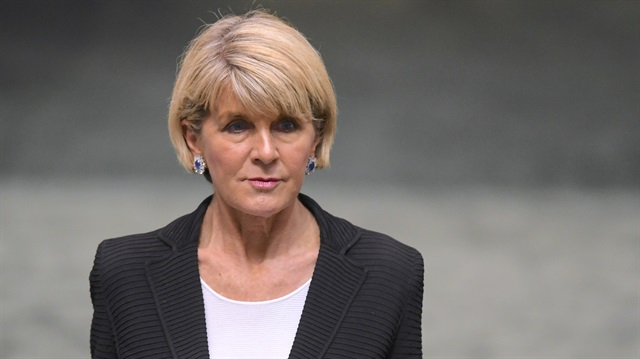
Australian Foreign Minister Julie Bishop
Australian Foreign Minister Julie Bishop said on Sunday she has resigned from new Prime Minister Scott Morrison's Cabinet, two days after a bruising leadership battle that toppled former prime minister Malcolm Turnbull.
Bishop announced she would move to the backbench and had not yet decided whether to contest the next election, which is due by May 2019. That decision could have serious implications for Morrison's government, which has a parliamentary majority of only one seat.
Morrison emerged as the surprise winner of Friday's party-room vote to replace Turnbull after a week of political chaos in Canberra that marked the emergence of Australia's sixth prime minister in less than 10 years.
He took over as leader of the Liberal Party, the senior partner in a Liberal-National coalition that has consistently trailed the opposition Labor party in opinion polls in recent months.
Bishop contested Friday's vote but was eliminated in the first round, with Morrison then emerging as a surprise compromise winner over Peter Dutton, Turnbull's conservative challenger who brought the leadership crisis to a head earlier in the week.
"I will remain on the backbench as a strong voice for Western Australia," Bishop said in a statement soon after she arrived back in her home state.
The possibility that Bishop could leave parliament before the next election will be a major concern for Morrison, Turnbull's former treasurer, because it opens the possibility of another by-election being held for her seat.
His party will already have to contest a by-election for Turnbull's harbourside electorate in Sydney, traditionally a safe Liberal seat. Turnbull's resignation from parliament was expected in the coming week.
Morrison has spent his first two full days in power working on a new Cabinet, although the only confirmed change so far is that his Liberal deputy and former energy minister Josh Frydenburg will take over as treasurer.
Treasurer Scott Morrison will become Australia's new prime minister after winning a Liberal party leadership vote on Friday, ending an internecine battle that has scarred the conservative government ahead of an election due by May 2019.Morrison's victory, however, may not end the political uncertainty in Australia with outgoing prime minister Malcolm Turnbull saying he would resign from parliament, forcing a by-election and risking the government's one-seat majority.The Liberal party is the senior partner in the conservative Liberal-National coalition government that has consistently trailed opposition Labor in opinion polls in recent months. Bookmakers on Friday had Labor a favourite to win the next poll.Morrison will be Australia's sixth prime minister in less than 10 years after winning a three-way race with former home affairs minister Peter Dutton, who brought on the latest political crisis, and Foreign Minister Julie Bishop.Turnbull, who called the leadership meeting after losing the majority support of the party, opted not to contest the vote. Turnbull told reporters after the vote he would leave parliament "not before too long".Turnbull blamed his demise on "vengeance, personal ambition, factional feuding" in his party, led by conservative lawmakers including former prime minister Tony Abbott, the man he toppled in a party-room coup in September 2015."Australians will be dumbstruck and so appalled at the conduct of the past week," said Turnbull. No sitting prime minister has lasted a full term in the past decade.Australia's new PM says no plans for an early election'Revolving Doors'Liberal party member Warren Entsch said after the leadership vote: "This revolving door of prime ministers has got to stop."The Liberal party leadership battle was sparked on Tuesday when Dutton launched an unsuccessful challenge to Turnbull. Under intense pressure to call a second vote, Turnbull convened a party meeting on Friday after receiving a letter signed by the majority of party members calling for a change of leader.Morrison defeated Dutton in a final party room ballot 45-40.His victory was welcomed by financial markets, which have been rocked by the political instability. Australian shares edged higher on Friday, rebounding after three days of losses that saw the benchmark fall 1.5 percent."PM Morrison is the most market-friendly option," said Annette Beacher, Chief Asia-Pac Macro Strategist at TD Securities in Singapore.However, Beacher said markets would be looking to see whether Morrison can narrow the gap with opposition Labor."The skew towards the Labor party at this stage ensures they will form government at the next election," she said.It was also hoped Morrison would end the political instability that has plagued Australia."The political turmoil of the past decade has come at the cost of our global competitiveness ... the business community needs policy certainty to promote investment and improve business confidence." said Tony Johnson, chief executive officer of Ernest & Young.However, Morrison's narrow victory suggested possibly more political instability, said Shane Oliver, chief economist at AMP Capital."Scott Morrison's relatively low margin of victory still poses the risk that there may still be more turmoil ahead," he said.
Australian Treasurer wins ballot to be next prime minister
Australia's incoming prime minister Scott Morrison hosed down speculation of an early election and said on Friday a severe drought across the country's east will be his immediate priority."I don't think anyone should be making any plans for an election any time soon," Morrison, the former treasurer, told reporters in Canberra.Energy minister Josh Frydenberg will be the new treasurer, Morrison announced after winning a Liberal party leadership vote earlier in the day. Australia bans China's Huawei from mobile network project, angers BeijingAustralian consulate in Indonesian city boosts security after threatAustralia foreign minister Bishop to run for PM
Australia's new PM says no plans for an early election