

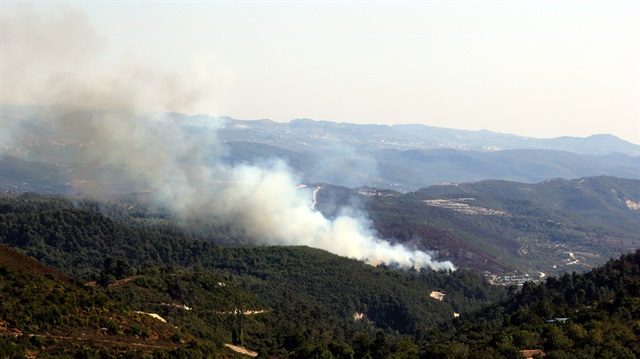
File photo
The Bashar al-Assad regime and its supporters have begun striking Turkmen Mountain in northwestern Syria’s Latakia province to capture the region, which falls within a network of de-escalation zones.
Artillery units of the regime forces on Friday night carried out intense attacks to the opposition’s frontline to seize the Turkmen Mountain region.
After seizing the previously opposition-held areas of Daraa and Quneitra, the Assad regime is attempting to gain full control of Turkmen Mountain, where Turkmens of Latakia reside, according to Anadolu Agency correspondents on the ground in Idlib.
Regime helicopters have started dropping flyers at various points in Syria’s opposition-held Idlib to threaten civilians. The propaganda warns, “Lay down your arms and collaborate with Assad!”The Assad regime and its Iran-backed Shia militia’ allies have already started to harass southern Idlib and speeded up its military deployments, dispatching dozens of troops, tanks, armored vehicles, missile-launching platforms and Iran-backed Shia militias along the Turkmen Mountain.The regime has also used its propaganda leaflets in the areas of Dera, Homs and Ghouta which it has captured in the past few months.On the other hand, last week, two Chinese diplomats raised the possibility of Chinese military operations in Syria’s Idlib alongside the Assad regime.Idlib, located in northwestern Syria on the Turkish border, has faced intense attacks by the Bashar al-Assad regime after a vicious civil war broke out in 2011. Since March 2015, Idlib is no longer under the control of the Assad regime and has been overrun by opposition groups.Turkey has stated that any attack on Idlib would result in the country withdrawing from the Astana talks and lead to a great disaster. The Astana peace talks were launched on Jan. 23-24, 2017, with the aim of putting an end to violence and improving the humanitarian situation in war-torn Syria.
Assad uses airborne leaflets to threaten civilians in Idlib
Artillery units of the regime forces on Friday night carried out intense attacks to the opposition’s frontline to seize Turkmen Mountains.
Over the past month, the regime, Iran-backed militia groups, and the pro-Syrian regime militia THKP-C led by Mihrac Ural have been conducting reconnaissance patrols, military build-up and artillery shootings for determining location at the frontline.
Amid Syria’s humanitarian suffering due to the seven-year civil war, over the past four months the U.S.-backed YPG/PKK terror group has increased its occupation of Syrian lands from 25 percent to 28 percent.According to map calculations by Anadolu Agency, between April 18 and Aug. 8, both the terror group YPG/PKK and the Assad regime increased their areas of dominance while the military opposition and terror group Daesh lost ground. Over the past four months, the Assad regime has increased by 1 percent its control over Syria, now controlling 109,136 of Syria’s total area of 185,180 square kilometers.While sometimes violating the Astana deal with Russian air support, the Assad regime has recently seized previously opposition-held areas of Eastern Ghouta, Daraa, and Quneitra.Four PKK terrorists surrender in southeastern TurkeyTerrorist YPG/PKK and DaeshWith the loss of Afrin due to Turkey’s Operation Olive Branch earlier this year, which rid a large part of Turkey's borders of the terrorist group, the YPG/PKK lost some ground but also stepped up its occupation of eastern parts of the country.In its more than 30-year terror campaign against Turkey, the PKK -- recognized as a terror group by the U.S., EU, and Turkey -- has claimed some 40,000 lives, including many women and children. The YPG is its Syrian branch, as documented by Turkey, but denied by the U.S.The terror group, backed by U.S. air support, increased its occupation in Syria from 51,379 to 45,967 square kilometers, boosting its area of dominance from 25 percent to 27.7 percent. The terror group Daesh, for its part, is currently present in three different areas in Syria totaling 6,040 square kilometers. Having earlier lost some 3,700 kilometers, the terror group's occupation of Syrian soil has dropped 3.3 percent since April.Today, Daesh is present in some the villages on the eastern side of the Euphrates River, eastern rural sections of Homs, and certain districts in As-Suwayda.Assad regime takes awaychildren’s right to educationOpposition to Assad regimeAfter losing Damascus’ Eastern Ghouta suburb in April, the military opposition and anti-regime armed groups left the Daraa and Quneitra provinces to regime forces, within the framework of a deal.The opposition’s area of dominance nationwide thus fell to 18,625 square kilometers, or about 10 percent of Syria.US marine in Syria reportedly shot by YPG/PKKToday the opposition maintains control over the northwestern province of Idlib, western Aleppo, northern rural areas of Mt. Turkmen in Latakia, and the Al-Tanf region, near Syria’s borders with Iraq and Jordan. Some 4,147 of the opposition-controlled 18,625 square kilometers is included within the zones liberated by Turkey's operations Euphrates Shield and Olive Branch.Some 7,700 square kilometers of the Al-Tanf region in eastern Syria are currently under U.S.-backed opposition control.
Amid shifts, terrorist YPG controlling more of Syria
According to opposition sources, Turkmen Mountain carries great importance since it is on the Idlib-Latakia route, and if it is seized, the regime will have full control of Latakia.
The regime also conducted land- and airstrikes in two villages and a town in Idlib Friday night, east of the Turkmen Mountains.
Special Advisor to the UN Special Envoy for Syria Jan Egeland on Thursday said that the UN will request Turkey to keep its borders open for civilians to flee if a battle breaks out in Syria’s opposition-held Idlib.The United Nations also warned that an offensive in the northwestern province could force 2.5 million people towards the Turkish border in the event of an offensive. “Russia, Iran and Turkey told a meeting of the Syria humanitarian taskforce on Thursday that they would do their utmost to avoid a battle that would threaten millions of civilians in opposition-held Idlib,” Egeland added.Amid shifts, terrorist YPG controlling more of SyriaThe Syrian Observatory for Human Rights also said that additional government forces were arriving for a possible attack in an area to the southwest of Idlib city that overlaps with Latakia and Hama provinces.The Assad regime and its Iran-backed Shia militia’ allies have already started to harass southern Idlib and speeded up its military deployments, dispatching dozens of troops, tanks, armored vehicles, missile-launching platforms and Iran-backed Shia militias along the Turkmen Mountain.Assad uses airborne leaflets to threaten civilians in IdlibThe regime has also started using its airborne propaganda leaflets in Idlib to threaten civilians."Your cooperation with the Syrian Arab Army will release you from the rule of militants and terrorists, and will preserve your and your families' lives. We call upon you to join local reconciliation (agreements) as many others in Syria have done," the leaflets read.Idlib, located in northwestern Syria on the Turkish border, has faced intense attacks by the Bashar al-Assad regime after a vicious civil war broke out in 2011. Since March 2015, Idlib is no longer under the control of the Assad regime and has been overrun by opposition groups.
'UN will request Turkey to keep borders open for Syrians fleeing Idlib'
In 2015, the regime -- backed by Russian air power -- captured some 85 percent of Latakia’s Turkmen Mountain region, forcing some 20,000 of the area’s Turkmen and Arab inhabitants to flee northward to Turkey.
Since the start of the Syrian civil war in 2011, the Assad regime has deliberately targeted civilian infrastructures such as hospitals, schools and mosques in heavy air and ground attacks.A special report by the Syrian Network for Human Rights (SNHR) revealed that over 1,356 schools were targeted across the country between March 2011 and August 2018. These attacks on educational infrastructures resulted in the death of at least 171 children and 528 civilians.The NGO said more than half of the schools have been left unserviceable by attacks carried out by regime forces, Russian warplanes, a U.S.-led coalition, Daesh and YPG/PKK terrorist organizations and anti-regime opposition groups.US rips Assad regime over death noticesThe rights group noted that the number of attacks has sharply increased since 2015 when Russian forces began its massive air campaign in support of Syrian regime forces.According to the NGO, regime forces carried out 996 attacks on schools, while Russian warplanes were responsible for 169 attacks.The U.S.-led coalition launched 87 attacks on schools, while anti-regime groups were responsible for 36 attacks, Daesh launched 23 attacks and YPG/PKK terrorists carried out three attacks.Turkey to open sports facilities for youth in SyriaThe NGO said unidentified elements were responsible for 42 attacks on schools in Syria.Idlib province the most targetedDue to the regime’s indiscriminate attacks, many Syrian families are unable to send their children to schools. Instead, they have to work at an early age to support their families.Most of the government strikes are on the opposition-controlled areas, especially Idlib, which rendered most of the schools unserviceable.'Assad regime keeping over 500,000 captives in prisons'SNHR also said that a total of 361 schools have been damaged in the northwestern province of Idlib, 260 in Aleppo, 198 in Damascus and its countryside, 118 in Homs, 76 in Raqqah, 103 in Daraa, 122 in Hama, 106 in Deir ez-Zour, 8 in Hasakah and 4 in Latakia.Last month, Virginia Gamba, the UN special representative for children in armed conflict, said more than 7,000 children have been killed in Syria since 2011.The UN had earlier said that some 2.1 million Syrian children were unable to continue their education due to the ongoing conflict in Syria.UN awaits details of US-Russia plan on Syrian refugees
Assad regime takes away
children’s right to education
Under and earlier agreement endorsed by Turkey, Russia and Iran, Turkmen Mountain falls within a network of de-escalation zones in which acts of aggression are expressly forbidden.