

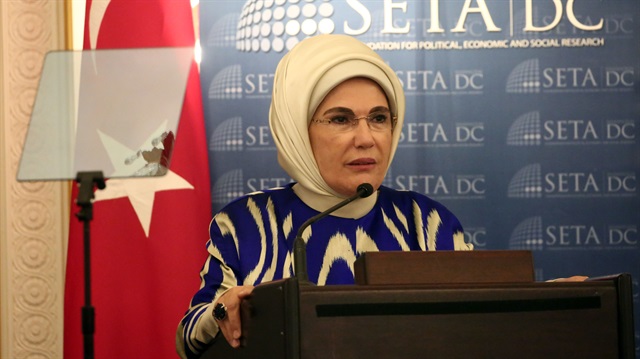
First lady Emine Erdoğan
Humanitarian aid must include efforts to reduce recipients’ dependency on it, Turkey’s First Lady Emine Erdoğan said Monday.
Speaking at a panel organized by the Turkish SETA Foundation in New York, Erdoğan highlighted that humanitarian aid policies should not increase the dependency of the recipients.
“Our [Turkey’s] vision of humanitarian aid is not about aid packages or vulnerable people waiting in line,” said Erdoğan, adding the country’s aid covers not only meeting basic needs but also prevention of crises and reducing dependency through development support.
“Therefore, humanitarian aid must also include efforts focusing on development,” she said.
Turning to Syrian refugees living in Turkey, who number more than three million and more than half of whom are women and children, Erdoğan said Ankara does not provide shelter alone.
“We place special importance on teaching women a profession to help their survival. We provide courses in many areas ranging from hairdressing to computer skills.
“We rehabilitate women who have suffered in the war through development programs and hobby courses and help them discover their potential,” she added.
As for children, she said, Turkey works to ensure that they are provided with education and young Syrian people are able to pursue their university studies.
She recalled that Turkey is also providing development aid to Africa.
“In other words, we are, to use a popular phrase, teaching them how to fish instead of providing the fish. We provide training and equipment to Africa that will help them discover their own potential,” she added.
Syria has only just begun to emerge from a devastating conflict that began in 2011 when the Bashar al-Assad regime cracked down on demonstrators with unexpected ferocity.
Turkish Foreign Minister Mevlüt Çavuşoğlu on Monday said that Turkey didnt leave innocent civilians to the mercy of the Syrian regime, nor to the Kurdistan Workers’ Party (PKK) or the Daesh terror group.“Unfortunately, the humanitarian burden of the Syria crisis has been upheaved on Turkey’s shoulders. Pledges should be fulfilled,” he added.In March 2016, the EU and Turkey reached an agreement to stop irregular migration through the Aegean Sea, and improve the conditions of more than 3 million Syrian refugees in Turkey.The EU had pledged €6 billion ($7.44 billion) in funding for the refugees, and promised to mobilize the second €3 billion ($3.72 billion) tranche by the end of 2018.Turkey is home to nearly three million Syrian people according to the Turkey’s Directorate General of Migration Management.This number accounts for around 45 percent of all Syrian refugees in the region, according to the UN.PKK ‘terror swamp’ east of Euphrates biggest issue for Syria, Erdoğan saysSyrian opposition welcomes Turkey-Russia deal on IdlibIraq, Syria swarming with approximately 10,000 foreign agentsTurkish, Russian, Iranian FMs to discuss Syria in NY
Turkey didn’t leave innocents to mercy of Syrian regime, says FM
At least 7 civilians were killed when they resisted YPG/PKK terrorists on a youth recruitment drive in an Arab-dominated village in Raqqa, Syria, local sources said on Monday.The incident occurred when the terror group raided al-Khatuniyyah village, said the sources, who spoke on condition of anonymity fearing for their security.The terrorists abducted many civilians, burnt several houses, and beat women and girls, the sources said.The village has been restive after the terror group sent forces to the village last week in a bid to arm the youths and pressurize civilians.On Friday, villagers attacked a building belonging to the terror group in the village and set ablaze three vehicles of the group.Separately, the terrorist group destroyed some stores belonging to civilians in Suwaidan Jazira village in the northeastern Syrian city of Deir Ez-Zor, the sources also noted.The terrorists also abducted scores of people when they held a demonstration to voice their reaction to their stores being destroyed.According to Anadolu Agency, around 28 percent of Syrian territory was occupied by the YPG/PKK terror group.PKK ‘terror swamp’ east of Euphrates biggest issue for Syria, Erdoğan saysTwo PKK terrorists ‘neutralized’ in SE TurkeyTurkish police discover link between PKK, Daesh terror groupsTurkish army ‘neutralizes’ 4 PKK terrorists in N. IraqYPG/PKK abducting civilians in N. Syria
Seven civilians killed as YPG/PKK raids Syrian village
The U.S. has accelerated efforts to gather informants in Syria’s north and east. Ahmad Jaber, a former top ranking Syrian intelligence official, spoke exclusively to Yeni Şafak daily, noting that in the past two years, over 3,000 informants were given duties in al-Hasaka, Raqqa, Deir ez-Zor, Manbij, Kobani and Tel Abyad.Jaber said that the U.S. uses aid organizations and churches to conduct these activities, and that CIA officials who travel to the region as health officials, education volunteers, city planners, religious officials and so forth are accompanied by over 70 Mossad agents.Neutralized on the border“Over 10 Western agents who came to the region with the aim of infiltrating Turkey were killed in the Turkish army’s latest bombardment of the Qandil area and border. They attribute importance to Afrin, Idlib, Jarabulus, al-Bab and Azaz. Agents are placed among civilians who flee from the PKK. Furthermore, individuals and families against the opposition are identified by Assad’s intelligence and included in this network. They conduct these activities under the guise of being ‘volunteers’ and ‘reporters.’ All the attacks carried out by the PKK-U.S. in Idlib, Afrin and the Euphrates Shield area are conducted as a result of the information and logistical support provided by these informants,” Jaber said.Approximately 10,000 agents in Syria, Iraq“The U.S. and Israel are leaders in efforts to gather informants in the region. France, Denmark, Britain, Canada and the Netherlands are also active. Many of the Western foreign fighters brought to the region to allegedly fight against Daesh were actually intelligence members of foreign countries. They formed certain connections on the field and many still have not cut these ties. Among these informants, over 200 are Westerners who have wed local women. Regardless of various periodical changes, there are approximately 10,000 agents in Syria and Iraq,” Jaber added.Churches and aid institutions used as intelligence centersOsama Muslim, a Kobani local who spoke to Yeni Şafak, said PKK controlled areas al-Hasaka, Tel Abyad, Rasool Ayn, Qamishli and Manbij were brimming with foreign agents. Muslim said those employed by Western education institutions and churches in these areas were all intelligence officials. Truckloads of US weapons continue to arm PKK terrorists in SyriaUS bolsters support to PKK terror group in SyriaTurkey to continue anti-terror activities in Syria
Iraq, Syria swarming with approximately 10,000 foreign agents