

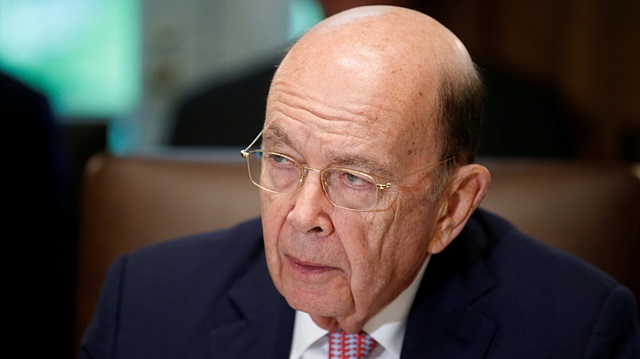
U.S. Commerce Secretary Wilbur Ross
U.S. Commerce Secretary Wilbur Ross said in an interview with CNBC on Wednesday that trade negotiations with China appear to have taken a brief pause, and he damped expectations that an agreement would come out of an upcoming G20 meeting.
"In any negotiation there are ups and downs, there are hiatuses, and there are much more active periods. So it appears as though we may be in something of a hiatus now," he said.
"Meetings of leaders at the G20 never get into huge amounts of detail. Those are meetings that are designed to be broad policy statements."
U.S. Defense Secretary Jim Mattis on Wednesday visited a former American air base in southern Vietnam that will soon become the biggest-ever U.S. cleanup site for contamination left by the defoliant Agent Orange during the Vietnam War.Standing near a skull-and-crossbones warning sign meant to keep people away from toxic soil, Mattis was briefed by Vietnamese officials about the massive contamination area.In a possible sign of the sensitivity surrounding Agent Orange in Vietnam, where millions of people are still suffering its effects, reporters were not allowed to attend the outdoor briefing for Mattis at Bien Hoa Air Base."I came to show the support of the Defense Department for this project and demonstrate that the United States makes good on its promises," Mattis told his Vietnamese counterpart at a closed-door meeting later in nearby Ho Chi Minh City.US sanctions on Iran show 'spitefulness' toward Iranian people: foreign ministryCleanup is expected to start getting under way early next year.U.S. troops dropped Agent Orange during the Vietnam War to clear thick jungle. But it contributed to severe health problems that, according to the U.S. Department of Veterans Affairs, can include Parkinson's Disease, prostate cancer and Chronic B-cell Leukemia.Of the 4.8 million Vietnamese who were exposed to Agent Orange, some three million are still dealing with its effects, including children born with severe disabilities or other health issues years after their parents were exposed, according to the Hanoi-based Vietnam Association for Victims of Agent Orange.US senator blasts Trump over Khashoggi caseWARMING RELATIONSMore than four decades after the Vietnam War ended in 1975, ties between the United States and Vietnam are less seen through the prism of the conflict and more through shared concerns over China.Vietnam has emerged as the most vocal opponent of China's territorial claims in the South China Sea and has been buying U.S. military hardware, including an armed, Hamilton-class Coast Guard cutter.The United States, in turn, accuses China of militarising the strategic waterway, through which more than $3 trillion in cargo passes every year, and sees Vietnam as a crucial ally in drawing regional opposition to Beijing's behavior.But U.S. officials including Mattis - who is on his second trip to Vietnam just this year - hope that addressing America's wartime legacies like Agent Orange can become a vehicle for further strengthening ties.When a U.S. aircraft carrier visited Vietnam in March, for example, one of the places U.S. sailors visited was a Vietnamese shelter for people suffering from the effects of Agent Orange.The United States just completed a five-year, $110 million program that cleaned soil contaminated by Agent Orange at Danang International Airport, which was one of the main air bases used for storing and spraying the herbicide between 1961 and 1971.But officials from the U.S. Agency for International Development, which is overseeing the project, said the Bien Hoa site will be four times larger than Danang, a massive undertaking that is expected to cost $390 million, according to a factsheet distributed to reporters.According to the U.S. Congressional Research Service (CRS), one soil sample from Bien Hoa had a "toxic equivalency," or TEQ, of more than 1,000 times over the international limit.A 2011 study conducted by a private consulting firm determined that contaminated soil had spread from hot spots at the base into nearby lakes, ponds, creeks, and drainage ditches, increasing the amount of soil and sediment that will require treatment."The impacts on the community is very difficult to measure. Dioxin has impacts (on health) at very low concentrations and they're not real consistent," one of the U.S. AID officials said, speaking on condition of anonymity. 
US prepares for biggest-ever Agent Orange cleanup in Vietnam
A Chinese daily criticized the U.S for its “double standards” toward the case of a Saudi journalist Jamal Khashoggi, who went missing after entering Saudi Consulate in Istanbul earlier this month.In an editorial with a headline “Khashoggi case tests Washington’s attitude to human rights,” Global Times said U.S. President Donald Trump promised punishment if the Riyadh’s involvement in Khashoggi's death is confirmed but he doesn't support stopping weapon sales to Saudi Arabia."The crisis has shown how human rights issues are positioned in the diplomatic arena. Killing a journalist for political reasons touches the bottom line of individual rights and causes wide resonance beyond national borders,” the daily wrote."The price it (Saudi Arabia) will pay depends on whether the Trump administration will let it off the hook for the sake of US commercial interests and geopolitical calculations," it is said.Turkey hopes to enter Saudi consul’s residence on Wednesday: FMKhashoggi has long been feared killed at the Saudi consulate in Istanbul after he entered on Oct. 2 and was never seen exiting.On the same day, 15 Saudis, including several officials, arrived in Istanbul on two planes and visited the building while Khashoggi was still inside, Turkish police sources said. All of the identified individuals have since left Turkey.Saudi authorities have yet to give a clear explanation of Khashoggi’s fate, while several countries -- particularly Turkey, the U.S. and the U.K. -- have expressed their desire that the matter should be elucidated as soon as possible.The daily compared the approach of the West toward missing Saudi journalist and former Russian agent Sergei Skripal's poisoning in the U.K. in March.It said the Western countries -- led by the Britain -- took an immediate action against Russia by expelling Russian diplomats after former Russian agent Sergei Skripal got poisoned in the city of Salisbury in early 2018, but there were very few denunciations from the West against Saudi Arabia upon Khashoggi's disappearance."Now Western public opinion is much angrier toward Saudi Arabia. Spontaneous boycotts quickly took place. But in contrast, fewer denunciations come from the Western governments and no country is taking the lead in punishing Saudi Arabia," the newspaper added.Saudi consul general leaves Turkey for RiyadhSergei Skripal and his daughter were admitted to a hospital after being found unconscious on March 4 in the English city of Salisbury. They have both since been discharged.Police officer Bailey, who was among the first to respond to the incident, also received treatment after being poisoned.Sergei Skripal was granted refuge in the U.K. following a 2010 spy exchange between the U.S. and Russia. Before the exchange, he had been serving a 13-year prison term for leaking information to British intelligence.The British government has claimed that in the most debated incident in Salisbury last March, two Russian military intelligence agents who were identified as Ruslan Boshirov and Alexander Petrov used a banned nerve agent called novichok targeting former Russian spy Sergei Skripal and his daughter Yulia.Leading US senator accuses Saudi prince of ordering Khashoggi killingEvidence found in Saudi consulate proving Khashoggi was killed there
Chinese daily slams approach of US over Khashoggi case