

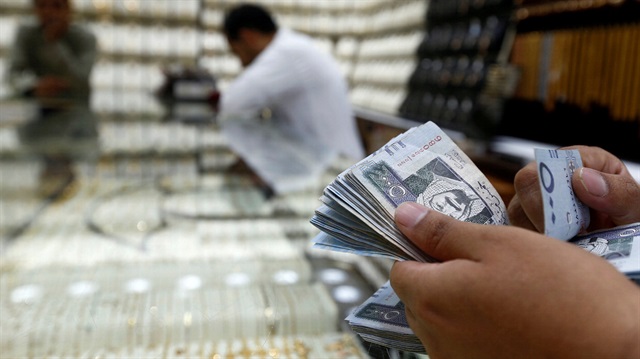
File photo
Saudi Arabia's riyal was quoted at 3.7514 to the U.S. dollar in the spot market early on Monday, its weakest rate since June 2017, Refinitiv data showed, as the kingdom faced pressure over missing journalist Jamal Khashoggi.
The central bank maintains a peg of 3.75 riyals to the dollar, and usually, the currency fluctuates in a range of about 3.7498-3.7503.
Saudi financial markets have come under pressure in the last few days as U.S. President Donald Trump has threatened to punish Riyadh if it turns out that Khashoggi was killed in the Saudi consulate in Istanbul as alleged by the Turkish authorities. The stock market sank 3.5 percent on Sunday.
Asian shares slipped on Monday as worries over Sino-U.S. trade disputes, a possible slowdown in the Chinese economy and higher U.S. borrowing costs tempered optimism despite a rebound in global equities late last week.Spreadbetters expected European stocks to open mixed, with Britain's FTSE edging up 0.15 percent, Germany's DAX dipping 0.1 percent and France's CAC losing 0.3 percent.Not helping the mood, oil prices jumped and Saudi Arabian shares tumbled on rising diplomatic tensions between Riyadh and the West after the monarchy warned against threats to punish it over disappearance of a journalist critical of its policies.MSCI's broadest index of Asia-Pacific shares outside Japan fell 1 percent while Shanghai shares were down 0.75 percent.Japan's Nikkei slumped 1.8 percent, with carmaker shares hitting 13-month lows after Washington said it would seek a provision about currency manipulation in future trade deals with Japan.MSCI's broadest gauge of the world's stock markets was off 0.25 percent after a sizable 3.87 percent decline last week - its biggest since March - to a one-year nadir.The market shakeout has been blamed on a series of factors, including worries about the impact of a U.S.-China trade war, a spike in U.S. bond yields and caution ahead of the earnings season.China echoes IMF pledges to avoid using currency as trade war toolAlthough selling appeared to have abated on Friday, partly after Chinese trade data showed strong growth in September, many investors remained cautious."Some people say markets drew comfort from China's exports data. But to me it seems so obvious the numbers were inflated by front-loading ahead of the introduction of tariffs," said Norihiro Fujito, chief investment analyst at Mitsubishi UFJ Morgan Stanley Securities.Fujito said the trade war is starting to take a toll on growth in China, noting that data released later on Friday showed Chinese auto sales posted the biggest drop in seven years.Over the weekend, China central bank governor Yi Gang said he still sees plenty of room for adjustment in interest rates and the reserve requirement ratio (RRR), as downside risks from trade tensions with the United States remain significant.Also starting to attract wider attention, Saudi Arabia doubled down on pressure from the West on the disappearance of Jamal Khashoggi, a U.S. resident and Washington Post columnist, after he entered the Saudi consulate in Istanbul on Oct. 2.U.S. President Donald Trump has threatened "severe punishment" if it turns out Khashoggi was killed while many company executives have cancelled their plans to attend a Saudi investor conference later this month.Saudi stocks plunge 7 pct on Khashoggi fallout; biggest drop since 2014Investors suspect the latest development could undermine the leadership of Crown Prince Mohammed bin Salman and has the risk of eventually destabilising the oil-rich kingdom.Saudi Arabia's shares plunged as much as 7 percent on Sunday, and closed down 3.5 percent at their lowest levels since early January.Oil prices reversed their downtrend since early this month.Brent crude futures rose 1.3 percent to $81.50 per barrel, bouncing back from Friday's near-three-week low of $79.23."Oil prices could rise to $100 on worries about Saudi Arabia," said Kazuhiko Fuji, senior fellow at Research Institute of Economy, Trade and Industry, a think tank affiliated with the Japanese government."People had thought the Saudis will make up for fall in Iran's output. If they are starting to use oil as their weapon, that will be a whole new chapter," he said.Higher oil prices could boost inflation around the world and spark rises in U.S. borrowing costs, which are also seen hurting weak borrowers, especially those in emerging markets.World oil market 'adequately supplied for now': IEAAlthough the U.S. 10-year yield posted its first major fall in about two months last week on stock market rout, the yield rose a tad on Monday to 3.15 percent.Investors were also bracing for a European Union summit meeting from Wednesday.The British pound shed 0.3 percent to $1.3114 after negotiators from the European Union and the UK failed to clinch a Brexit deal ahead of the crucial summit.The euro traded at $1.1552, down slightly after Chancellor Angela Merkel's Bavarian allies suffered their worst election result since 1950 on Sunday.On the other hand, the dollar is seen under pressure against the yen after U.S. Treasury Secretary Steven Mnuchin said on Saturday that Washington wants to include a provision to deter currency manipulation in future trade deals, including with Japan.That raised worried among Japanese policy circles that this would give Washington the right to label as currency manipulation any future foreign exchange market interventions by Tokyo to keep sharp yen rises in check.The dollar slipped 0.2 percent to 112.00 yen.At IMF meetings, China's globalisation agenda left behind in trade debate
Asian shares resume decline, Saudi tensions lift oil prices
Although the riyal's move was unusual, it was smaller than some bouts of instability in recent years; in November 2015, when oil prices were plunging, the riyal dropped as low as 3.7598.
Trade in the foreign exchange forwards market, which banks use to hedge against possible future currency moves, showed moderate pressure on the riyal early on Monday.
The dollar rose as high as 74 points against the riyal, an eight-month high, from 54 points on Friday. In 2016, it briefly rose above 1,000 points.
In a Sunday night phone call, Turkish President Recep Tayyip Erdoğan and Saudi King Salman bin Abdulaziz discussed the disappearance of journalist Jamal Khashoggi.Erdoğan stressed forming a joint working group to probe the case, said a Turkish presidential source, who spoke on condition of anonymity due to restrictions on talking to media.Khashoggi, a Saudi journalist and columnist for The Washington Post, has gone missing since he entered the Saudi Consulate in Istanbul on Oct. 2.On that same day 15 other Saudis, including several officials, arrived in Istanbul on two planes and visited the building while Khashoggi was also inside, Turkish police sources said. All of the identified individuals have since left Turkey.Saudi authorities have yet to give a clear explanation of Khashoggi’s fate, while several countries -- particularly Turkey, the U.S., and the U.K -- are pressing for the case to be cleared up as soon as possible.US Treasury Secretary Mnuchin still plans to attend upcoming Saudi summitSaudi threatens to retaliate against any sanctions over Khashoggi disappearanceUK's Labour says it would stop selling arms to Saudi ArabiaSaudi stocks plunge 7 pct on Khashoggi fallout; biggest drop since 2014Turkey expects Saudi cooperation on case of missing journalist: FMTrump says Saudi Arabia faces 'severe punishment' if Khashoggi was killed
Erdoğan, Saudi King discuss Khashoggi case over phone