

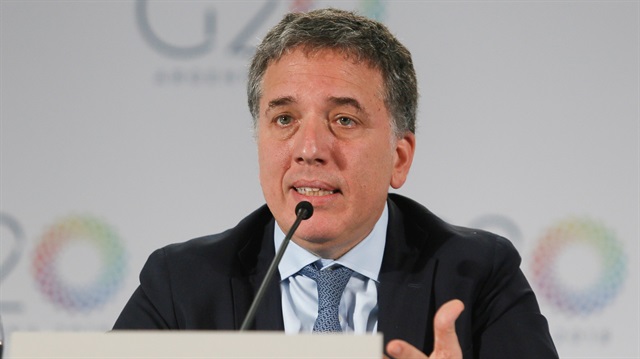
Argentina's Minister of Treasury Nicolas Dujovne gives statements during G20 news conference at the International Monetary Fund - World Bank Annual Meeting 2018 in Nusa Dua, Bali, Indonesia, October 12, 2018.
Trade tensions within the Group of 20 leading industrialised and emerging economies could only be solved by the countries directly involved, the chairman of a meeting of finance leaders from the G20 said after a gathering in Bali on Friday.
Taking place on the sidelines of the International Monetary Fund and World Bank meetings on the Indonesian island, the G20 meeting provided little more than a forum for member countries to put their viewpoint on an escalating tariff war between the United States and China, the world's two biggest economies.
"We recognise we are now facing trade tensions among members of the G20," Argentine Treasury Minister Nicolas Dujovne, chairman of this year's G20 finance leaders' meeting, told a news briefing, without directly mentioning either the United States or China.
"The G20 can play a role in providing the platform for discussions. But the differences that still persist should be resolved by the members that are directly involved in the tensions."
Indonesian President Joko Widodo urged global central bankers and finance ministers on Friday to guard against growing risks facing the world's economy, as a heated a Sino-U.S. trade war roils both emerging and developed markets.At the plenary session of the International Monetary Fund and World Bank meetings being hosted by Indonesia, Widodo peppered his speech with references to the HBO series "Game of Thrones", where families and kingdoms battle for power in a fictional continent, to explain risks facing the global economy."All these troubles in the world economy, are enough to make us feel like saying: 'Winter is Coming'", he said, using a phrase that characters in the popular fantasy series often use to refer to the lurking threats that could destroy them.The meetings, attended by more than 19,000 delegates and other guests, including ministers, central bank heads and some leaders, come at a time of renewed tumult in global financial markets as investors dumped hundreds of billions of dollars worth of equities from Wall Street to European and Asian bourses.China trying to sway US vote, poses threat: officialsThe fear is that the China-U.S. trade row could upend global supply chains, and chill international trade and investment - a risk underscored by Widodo.Widodo said with growing rivalry in the world economy, "the situation could be more critical compared to the global financial crisis 10 years ago."He did not single out any one country but emerging markets, like Indonesia, have been battered by stormy conditions amid worries about the impact of an escalating Sino-U.S. trade war and monetary policy tightening in advanced economies.The market ructions have now cascaded through to developed markets with Wall Street extending a slide into a sixth session on Thursday amid the trade war fears.US says China spy charged with trying to steal aviation secretsThe United States and China have slapped tit-for-tat tariffs on hundreds of billions of dollars of each other's goods over the past few months.The tariffs stem from the Trump administration's demands that China make sweeping changes to its intellectual property practices, rein in high-technology industrial subsidies, open its markets to more foreign competition and take steps to cut a politically sensitive U.S. goods trade surplus. Potentially further inflaming tensions, China reported on Friday an unexpected acceleration in export growth in September and a record trade surplus with the United States. China's trade surplus with the United States was $34.13 billion in September, breezing past August's $31.05 billion."Lately it feels like the relations among the major economies are becoming more and more like "Game of Thrones"," said Widodo."Are we so busy fighting with each other and competing against each other that we fail to notice the things which are increasingly threatening, all of us alike, rich and poor, large and small."IMF chief says China faces balancing act as it seeks to maintain growthG20 MEMBERS NEED TO RESOLVE TRADE TENSIONSEarlier this week, the IMF cut its global economic growth forecasts for both 2018 and 2019 to 3.7 percent, from 3.9 percent in its July forecast, saying that the trade war was taking a toll and emerging markets were struggling with tighter liquidity and capital outflows.Separately on Thursday, the fund warned in its twice-yearly report on the Asia Pacific region that the market rout seen in emerging economies could worsen if the Federal Reserve and other major central banks tightened monetary policy more quickly than expected.Nicolas Dujovne, chairman of this year's G20 finance leaders' meeting, said that tensions remained among the group on trade that must be solved among countries directly involved."The G20 can play a role in providing the platform for discussions," Dujovne, who is Argentina's Treasury Minister, told a news conference after the group's meeting in Bali."But the differences that still persist should be resolved by the members that are directly involved in the tensions," he said.In his speech, Widodo called on finance ministers and central bank governors gathered in Bali to "cushion the blows from trade wars, technical disruption and market turmoil"."I hope, you will each do your part to nudge our various leaders, in the right direction," Widodo said, adding that "confrontation and collision impose a tragic price".At the plenary, IMF managing director Christine Lagarde estimated that the escalation of current trade tensions could reduce global GDP by almost one percent over the next two years."Clearly, we need to de-escalate these disputes," Lagarde said.
Winter is coming: Indonesia warns of new crisis from trade war
The United States and China have slapped tit-for-tat tariffs on hundreds of billions of dollars of each other's goods over the past few months, jolting financial markets and stoking fears the rising tide of protectionism could dent global growth.
Dujovne said that while global growth projections remain steady, the expansion has become less even across economies as downside risks materialised.
"On trade tensions, we agree that international trade is an important engine of growth, and that we need to resolve tensions which can negatively affect market sentiment and increase financial volatility," he said.
Tensions remained among the G20 group on trade that must be solved among countries directly involved, said Nicolas Dujovne, chairman of the group's finance leaders' meeting."We recognize we are now facing trade tensions among members of the G20," Dujovne, Treasury Minister of this year's G20 chair Argentina told a news conference on Friday."Part of those tensions will have to be resolved by the members," he said, after the group's meeting in the Indonesian resort island of Bali."The G20 can play a role in providing the platform for discussions. But the differences that still persist should be resolved by the members that are directly involved in the tensions." 
G20 chair says trade tensions must be solved by countries involved
Dujovne sidestepped a question on how Japan ought to deal with trade frictions when it chairs the G20 meetings next year, saying only that "Japan will be the one deciding on the priorities."
Japanese Finance Minister Taro Aso told reporters on Thursday that Tokyo hopes to discuss ways to fix global imbalances at next year's G20 gatherings.
The G20 finance leaders did not produce a joint communique after their two-day meeting ended on Friday.