

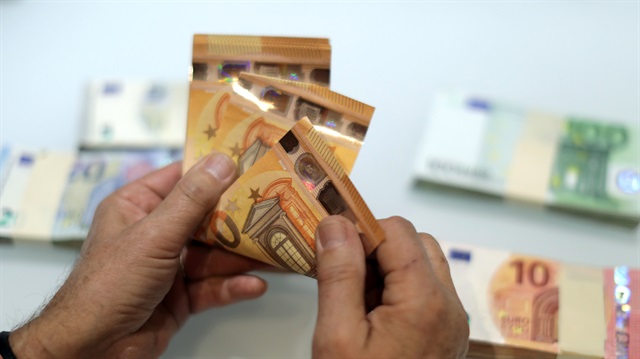
File photo
European shares rose cautiously early on Monday as optimism on the trade war front was lifted by a new U.S.-Mexico-Canada agreement, which is helping world markets enter the fourth quarter on a positive footing.
At 0720 GMT, the euro zone benchmark was up 0.2 percent with most European bourses and sectors trading in positive territory.
"News overnight of a late agreement between the U.S. and Canada to salvage the NAFTA trade agreement should give a boost to global risk appetite at the start of the fourth quarter," wrote Peel Hunt strategist Ian Williams, adding the deal "may offer encouragement that the other global trade disputes can settled satisfactorily."
Ryanair was the worst performer, down 7.5 percent after it cut its forecast for full-year profit and said there could be worse to come if recent coordinated strikes across Europe continue to hit traffic and bookings.
The low cost carrier's fall weighed on the wider sector which was one of the only ones in the red, down 0.6 percent.
Germany's Linde posted the highest rise after it received approval for its proposed $83 billion merger with Praxair PX.N from the Chinese antitrust authorities.
Italian banks were down 0.3 percent after Italian daily La Repubblica reported that the European Commission was set to reject Italy's budget plans in November and open a procedure against the country's public accounts.
The dollar slipped against the Canadian dollar on Monday as the United States and Canada reached a framework deal to update the North American Free Trade Agreement.Sources with direct knowledge of the talks confirmed the two countries reached a deal, which involved offering more dairy access to U.S. farmers as well as Canada agreeing to a side-letter arrangement effectively capping automobile exports to the United States.A Mexican source close to the NAFTA talks separately said: "we have a trilateral deal."The Canadian dollar rose about 0.7 percent, reaching a four-month high of C$1.2814 as the news about the framework agreement broke, before giving up some gains. It last traded at C$1.2836.The loonie added to the previous session's gains of more than one percent."Though markets were already anticipating an agreement, one source of worry will be swept away if a deal is made," Yukio Ishizuki, senior currency strategist at Daiwa Securities in Tokyo, said."That will lead to a rise in trust in the U.S. economy, so it's easy for risk sentiment to improve.""The Canadian dollar is really strong today. Together with that, it's easy for currencies from resource-dependent and emerging market countries to rise, putting selling pressure on the dollar."Mexico's peso currency strengthened to a seven-week high versus the dollar, at one point gaining about 0.85 percent to 18.54 per dollar.The yen, meanwhile, weakened to 113.96 per dollar, reaching its lowest since the middle of November 2017 before paring some losses. It last traded 0.2 percent higher at 113.90 per dollar.The greenback has risen four straight weeks against the Japanese currency, including a nearly 1 percent gain booked last week.U.S. President Donald Trump's administration had said Canada must sign on to the text of the updated North American Free Trade Agreement before Monday local time or face exclusion from the pact. Washington has already reached a side deal with Mexico, the third NAFTA member.The dollar index, which measures the greenback against a basket of six currencies, edged less than 0.1 percent higher to 95.197, not far off a more than two-week high of 95.366 reached on Friday.For the third quarter, the dollar index posted its second consecutive quarterly gain, rising more than half a percent.The euro was down 0.1 percent at $1.1595, with worries about a rise in Italy's deficit weighing on the single currency after the Italian government agreed to set a higher than expected budget deficit target.The single currency gave up nearly 1.2 percent last week and traded close to a more than two-week low of $1.1569 touched on Friday.In Trump win, Canada, US deal saves NAFTA as trilateral pact
Canadian dollar hits four-month high as US, Canada reach NAFTA deal
The United States and Canada forged a last-gasp deal on Sunday to salvage NAFTA as a trilateral pact with Mexico, rescuing a three-country, $1.2 trillion open-trade zone that had been about to collapse after nearly a quarter century.In a big victory for his agenda to shake-up an era of global free trade that many associate with the signing of NAFTA in 1994, President Donald Trump coerced Canada and Mexico to accept more restrictive commerce with their main export partner.Trump's primary objective in reworking NAFTA was to bring down U.S. trade deficits, a goal he has also pursued with China, by imposing hundreds of billions of dollars in tariffs on imported goods from the Asian giant.While the new United States-Mexico-Canada Agreement (USMCA) avoids tariffs, it will make it harder for global auto makers to build cars cheaply in Mexico and is aimed at bringing more jobs into the United States.Since talks began more than a year ago, it was clear Canada and Mexico would have to make concessions in the face of Trump's threats to tear up NAFTA and relief was palpable in both countries on Sunday that the deal was largely intact and had not fractured supply chains between weaker bilateral agreements."It's a good day for Canada," Prime Minister Justin Trudeau told reporters after a late-night cabinet meeting to discuss the deal, which triggered a jump in global financial markets.In a joint statement, Canada and the United States said it would "result in freer markets, fairer trade and robust economic growth in our region".Negotiators worked frantically ahead of a midnight ET (0400 GMT) U.S. imposed deadline to settle differences, with both sides making concessions to seal the deal. The United States and Mexico had already clinched a bilateral agreement in August."It's a great win for the president and a validation for his strategy in the area of international trade," a senior administration official told reporters.Trump has approved the deal with Canada, a source familiar with the decision said. U.S. officials intend to sign the agreement with Canada and Mexico at the end of November, after which it would be submitted to the U.S. Congress for approval, a senior U.S. official said.Cost For CanadaThe deal will preserve a trade dispute settlement mechanism that Canada fought hard to maintain to protect its lumber industry and other sectors from U.S. anti-dumping tariffs, Canadian sources said.But it came at a cost.Canada has agreed to provide U.S. dairy farmers access to about 3.5 percent of its approximately $16 billion annual domestic dairy market. Although Canadian sources said its government was prepared to offer compensation, dairy farmers reacted angrily."We fail to see how this deal can be good for the 220,000 Canadian families that depend on dairy for their livelihood.” Pierre Lampron, president of Dairy Farmers of Canada, said in a statement."This has happened, despite assurances that our government would not sign a bad deal for Canadians."The deal also requires a higher proportion of the parts in a car to be made in areas of North America paying at least $16 an hour, a rule aimed at shifting jobs from Mexico.Canada and Mexico each agreed to a quota of 2.6 million passenger vehicles exported to the United States in the event that Trump imposes 25 percent global autos tariffs on national security grounds.The quota would allow for significant growth in tariff-free automotive exports from Canada above current production levels of about 2 million units, safeguarding Canadian plants. It is also well above the 1.8 million cars and SUVs Mexico sent north last year.But the deal failed to resolve U.S. tariffs on Canada's steel and aluminum exports.The Trump administration had threatened to proceed with a Mexico-only trade pact as U.S. talks with Canada foundered."It's a good night for Mexico, and for North America," Mexican Foreign Secretary Luis Videgaray said.The news delighted financial markets that had fretted for months about the potential economic damage if NAFTA blew up.U.S. stock index futures rose, with S&P 500 Index e-mini futures up more than 0.5 percent, suggesting the benchmark index would open near a record on Monday.The Canadian dollar surged to its highest since May against the U.S. dollar, gaining around 0.5 percent. The Mexican peso gained 0.8 percent to its highest against the greenback since early August."Though markets were already anticipating an agreement, one source of worry will be swept away if a deal is made," Yukio Ishizuki, senior currency strategist at Daiwa Securities in Tokyo, said."That will lead to a rise in trust in the U.S. economy, so it's easy for risk sentiment to improve."
In Trump win, Canada, US deal saves NAFTA as trilateral pact