

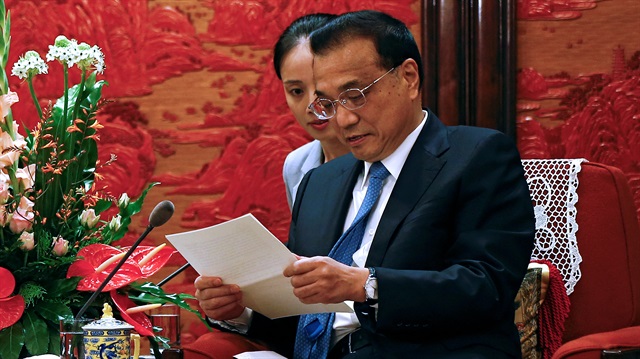
Chinese Premier Li Keqiang
China’s Foreign Ministry on Friday said Turkey was capable of dealing with "temporary economic difficulties".
“Turkey's stability and development are conducive to regional peace and stability,” Foreign Ministry spokesman Lu Kang said in a statement.
"China believes that Turkey has the ability to overcome temporary economic difficulties and hopes that all parties concerned will resolve their differences through dialogue,” Lu said.
Treasury and Finance Minister Berat Albayrak said on Thursday that Turkey fully understood and recognised all its domestic challenges and will come out of the current market volatility stronger.In a conference call with investors, Albayrak said Turkey was now dealing with the market anomaly and has a banking sector which is healthy and strong.The finance minister added that Turkey has no plans to go to the International Monetary Fund (IMF) for support over its currency crisis.Germany stresses importance of Turkish economyBefore he spoke, the Turkish lira strengthened more than 3 percent. The currency shrugged off U.S. comments ruling out the removal of steel tariffs on Turkey even if it frees an American pastor who lies at the centre of the complex feud between Washington and Ankara.The currency gained some support from the announcement late on Wednesday of a Qatari pledge to invest $15 billion in Turkey.Albayrak stated that Turkey would meet its fiscal target through tighter spending. It would also focus on attracting foreign direct investment, he said.Turkey will navigate through U.S. sanctions with other partnersA lot of countries across the globe are facing the problem of U.S. sanctions and the response to that should be a coordinated one, Albayrak said.Speaking to around 6,000 investors in his first such call since being appointed to the cabinet in July, Albayrak, said Turkey will navigate this period of U.S. sanctions with other parties such as Germany, Russia and China. Turkish government to see certain expenditure cutsThe minister announced that the government will see certain expenditure cuts and the revenue side was showing positive performance.Albayrak said he expected a 6 billion lira ($1.04 billion) primary surplus for the end of this year. ($1 = 5.7711 liras)Turkey won't hesitate to support banking sectorHe also said that Turkey won't hesitate to provide support to the banking sector, which was capable of managing current volatility, and there has not been major deposit flow from banks lately.Iraqi cleric urges support for Turkey amid row with USHe added that Turkey had already taken measures to curb forex funding and corporates are in a comfortable position to meet short-term liabilities.JP Morgan said that moves by Turkish authorities to curb the lira's fall showed they were committed to stabilising the currency with technical measures such as restricting foreign exchange swaps and cancelling repo auctions to push up the average cost of bank funding.Turkey will not compromise on fiscal disciplineTurkey will not compromise on fiscal discipline and reducing inflation is a top priority, Albayrak said.Albayrak expressed that Turkey was not a highly leveraged country and debt stood at 137 pct of GDP in the first quarter of 2018. All ministries have a mandate for ambitious savings, he added, and investment portfolios will be reviewed.Tunisia party head hails Turkish stand against hegemonyCapital controls not on agendaTurkey has never implemented non-market measures and capital controls will never be on the agenda, the finance minister added.Structural reforms and labour market flexibility are also a priority, he said.Uzbekistan calls for Turkish investmentsMacron tells Erdoğan Turkey's economic stability important for FranceAnkara municipality to stop issuing licenses for McDonald’s, Burger King'We won't let financial attacks hurt Turkish industry'
Albayrak says Turkey will come out of volatility stronger
Beijing always pays importance to China-Turkey cooperation in the fields of economy, trade and finance, he added.
Relations between Ankara and Washington have been rocky since Aug. 1, when the U.S. imposed sanctions on two Turkish government ministers after Turkey refused to release an American pastor facing terrorism-related charges.
Last week, U.S. President Donald Trump upped the ante by doubling U.S. tariffs on Turkish aluminum and steel imports.
In response, Turkey raised tariffs on several U.S.-made goods, including alcohol and tobacco products and vehicles.
China has invested 990 billion yuan ($143.63 billion) for a massive urban redevelopment project in the first seven months of 2018, the housing ministry said on Thursday.China's central bank has injected hundreds of billions of dollars into such shantytown redevelopment projects (SRP) through the Pledged Supplementary Lending (PSL) programme, which has been largely used for cash compensation to residents whose homes are demolished.The policy helped boost home sales and prices in smaller cities that struggled for years with a glut of unsold homes, playing a key role in reviving economic growth since 2015.Led by gains in smaller cities, China's new home prices accelerated at their fastest pace in almost two years in July, defying persistent government curbs.Turkey, China are neighbors and partners, says envoyIn 2017, China poured a record 1.84 trillion yuan ($278.21 billion) into the project, with new construction started on over six million homes that year, official data showed. The government is aiming to build another 5.8 million homes in 2018.China's shantytown spending so far this year is roughly equal to the market value of video streaming giant Netflix Inc.The housing ministry, in a statement on Thursday, said construction work began on 4.07 million homes in the first seven months this year.But ballooning property bubbles and hidden local debt risks as a result of credit stimulus from the project have sounded alarm bells for China's top leaders. The housing ministry said in July it will restrict subsidies for new shantytown development projects to cities with hot property markets.China rebuffs Philippines president's South China Seas rebukeIn late June, Reuters reported that China Development Bank (CDB) had halted funding for new shantytown redevelopment projects, and transferred approval authority from its local branches back to the policy bank's headquarters, in a sign of tighter scrutiny over the project.While Beijing is seen to significantly reduce the size of the project especially in low-tier cities in the future, it may be hesitant to dial back support too quickly amid a slowing economy.Economists at Nomura, in a note this week, said they believe that in the short term, Beijing will maintain a normal pace for financing all renovation projects "given the strong headwinds to China's economy".
China ploughs $144 bln into shantytown redevelopment so far in 2018