

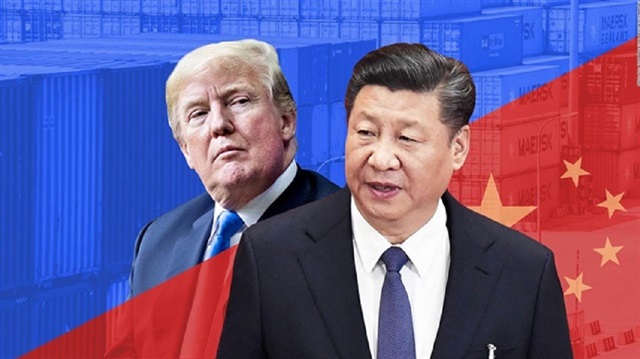
File photo
The United States and China imposed fresh tariffs on each other's goods on Monday as the world's biggest economies showed no signs of backing down from an increasingly bitter trade dispute that is expected to knock global economic growth.
Soon after the fresh duties went into effect, China accused the United States of engaging in "trade bullyism" and said it was intimidating other countries to submit to its will through measures such as tariffs, the official Xinhua news agency said.
But Beijing also said it was willing to restart trade negotiations with the United States if the talks are "based on mutual respect and equality," Xinhua said, citing a white paper on the dispute published by China's State Council.
U.S. tariffs on $200 billion worth of Chinese goods and retaliatory tariffs by Beijing on $60 billion worth of U.S. products took effect at midday Asian time, though the initial level of the duties was not as high as earlier feared.
The U.S. will levy tariffs of 10 percent initially, rising to 25 percent at the end of 2018. Beijing has imposed rates of 5-10 percent and warned it would respond to any rise in U.S. tariffs on Chinese products accordingly.
The two sides had already slapped tariffs on $50 billion worth of each other's goods.
For U.S. consumers, the new duties could translate into higher prices for Chinese products ranging from vacuum cleaners to technology gear such as home modems and routers, while U.S. goods targeted by Beijing include liquefied natural gas and certain types of aircraft.
President Donald Trump is pressuring China to reduce its huge bilateral trade surplus and make sweeping changes to its policies on trade, technology transfers and high-tech industrial subsidies. Beijing has denied accusations that U.S. firms are being forced to transfer technology and sees Washington's demands on rolling back its industrial policies as an attempt to contain China's economic rise.
The U.S. administration "has brazenly preached unilateralism, protectionism and economic hegemony, making false accusations against many countries and regions, particularly China, intimidating other countries through economic measures such as imposing tariffs," Xinhua quoted the State Council's white paper as saying.
Beijing released a white paper on the trade dispute saying it would seek a reasonable outcome, while also describing U.S. tactics as 'bullying' on Monday.
China releases white paper on trade friction with US
Both sides digging in
Several rounds of Sino-U.S. trade talks in recent months have yielded no major breakthroughs and attempts at arranging another meeting in coming weeks have fallen through.
China, which has accused Washington of being insincere in trade negotiations, has decided not to send Vice Premier Liu He to Washington this week, The Wall Street Journal reported late last week.
News of Beijing's decision to skip the talks pushed China's yuan currency down 0.3 percent on Monday in offshore trade, reinforcing global investors' fears that both sides are digging in for a long fight. Mainland China markets were closed for a holiday.
A senior White House official said last week the U.S. will continue to engage China, but added there was no date set for the next round of talks.
Economists warn that a protracted dispute will eventually stunt growth across the globe. Companies on both sides of the Pacific are already reporting disruptions to their operations and are reviewing investment plans.
The trade tensions have also cast a pall over broader relations between Beijing and Washington, with the two sides butting heads on a growing number of issues.
China summoned the U.S. ambassador in Beijing and postponed military talks in protest against a U.S. decision to sanction a Chinese military agency and its director for buying Russian fighter jets and a missile system.
Rob Carnell, ING's chief Asia economist, said in a note to clients that in the absence of any incentives Beijing would likely hold off on any further negotiations for now.
"It would look weak both to the U.S. and at home," he said, adding that there is "sufficient stimulus in the pipeline" to limit the damage of the latest tariffs on China's economy.
"The U.S.-China trade war has no clear end in sight."
China may also be waiting for U.S. mid-term elections early next month for any hints of changes in Washington's policy stance, Carnell added.
"With generic polls favouring the Democrats, they may feel that the trade environment will be less hostile after November 6."
China will cut import and export costs for foreign firms, Premier Li Keqiang said in comments posted by the central government on Sunday, as the world's second largest economy looks to promote an image of being open for business.The move comes as China is embroiled in a trade standoff with the United States, its largest trading partner. Beijing has made various pledges to open up sectors from autos to finance to more overseas investment.China will this year look to cut the amount of documentation needed for imports and exports by a third, lower customs fees and reduce the time needed to get customs clearance, the government said in the statement."We must strive to improve the business environment and reduce costs for foreign enterprises, and so push forward the opening up process and maintain stable growth of imports and exports," Li said.Li, speaking at the World Economic Forum in the Chinese port city of Tianjin earlier this week, said that China will continue to cut import tariffs on some goods and resolutely protect intellectual property, moves aimed at placating concerns from overseas trade partners.The statement said China would add fast-track channels for clearing certain imports including some agricultural products, and by the end of the year publish a list of products that would need to pay official port fees. Other products would be exempt.
China Premier Li says to reduce import-export costs, red tape
China has cancelled upcoming trade talks with the United States and will not send vice-premier Liu He to Washington next week, the Wall Street Journal reported, citing sources.The Wall Street Journal said a mid-level delegation was due to travel to Washington ahead of Liu's visit, but the trip has now been abandoned.Earlier this week, China added $60 billion of U.S. products to its import tariff list as it retaliated against U.S. duties on $200 billion of Chinese goods set to go into effect from Sept. 24. 
China cancels trade talks with US as tariff threats escalate
Washington readying more measures
Trump on Saturday reiterated a threat to impose further tariffs on Chinese goods should Beijing retaliate, suggesting that Washington may slap tariffs on virtually all imported Chinese goods if the administration does not get its way.
China imports far less from the United States, making a dollar-for-dollar match on any new U.S. tariffs impossible.
Instead, it has warned of "qualitative" measures to retaliate.
Though Beijing has not revealed what such steps might be, business executives and analysts say it could withhold exports of certain products to the U.S. or create more administrative red tape for American companies operating in China.
Some analysts say there is also a risk that China could allow its currency to weaken again to cushion the blow to its exporters.